The $43 Billion Question: Why “Reducing Sugar” Is No Longer a Marketing Trend
According to Persistence Market Research, the global natural sweetener market reached $28.2 billion in 2026 and is projected to hit $43 billion by 2033, growing at a 6.2% compound annual growth rate.
But here is what that number actually tells you: the growth is not driven by sweetness. It is driven by health anxiety. Consumers want to reduce sugar, but they refuse to sacrifice taste. That tension – the gap between what people want to eat and what they believe they should eat – is the single biggest opportunity for ingredient suppliers right now.
This article examines the five major natural sweetener players in 2026, the regulatory landscape across key markets, and the practical sourcing framework that formulators and procurement teams should use when evaluating suppliers.
I. What Is Actually Driving the Sugar Reduction Wave
It Is Not Just Regulations – It Is Consumer Psychology
The narrative around sugar reduction has shifted dramatically in the past five years. Five years ago, the question was simply how do we make this taste sweet without sugar? Today, the question is how do we make this taste sweet without sugar, and without any ingredient name that looks like it came from a lab?
Clean label pressure is the dominant force. Consumers are reading ingredient lists. They recognize sucrose, fructose, and glucose. They do not recognize aspartame, sucralose, or saccharin – and they do not want to. This has pushed formulation teams away from artificial high-intensity sweeteners and toward naturally derived alternatives, even when those alternatives cost more and perform less predictably.
The consequence is a market where “natural” is no longer a premium differentiator. It is a floor requirement. Brands that cannot demonstrate a credible clean-label sugar reduction pathway are losing shelf space to competitors who can.
The Real Bottleneck: Taste Plus Functionality
Sugar is not just a sweetener. In food formulations, sugar performs three distinct functions:
- Sweetness: the primary sensory attribute.
- Texture and mouthfeel: sugar contributes viscosity, bulk, and the perception of creaminess.
- Maillard browning and caramelization: sugar participates in the chemical reactions that create color and flavor in baked goods, roasted products, and cooked sauces.
Most sugar-reduction failures happen not because the product tastes too sweet or not sweet enough, but because the texture and browning functions are compromised. A beverage that tastes right but feels watery. A cookie that tastes right but does not spread or brown properly. These failures are functional, not sensory.
The winning approach addresses all three functions simultaneously. This is why multi-sweetener blending has become the industry standard rather than a niche technique.
II. The Natural Sweetener Landscape in 2026: Five Players, Five Different Jobs
The following five ingredients dominate the natural sweetener market. Each serves a different role in formulation, and each carries distinct regulatory, cost, and functional characteristics.
Erythritol
Erythritol is a sugar alcohol produced by fermenting glucose. It delivers approximately 70% of the sweetness of sucrose with zero calories and a zero glycemic index.
Best application: Beverages, chewing gum, chocolate, and products where bulk and mouthfeel matter more than intensity.
Key advantage: Clean taste with no bitter or metallic aftertaste, unlike many high-intensity natural sweeteners. It also provides measurable bulk, which means it can replace sugar on a weight-for-weight basis in many formulations.
Limitation: At concentrations above approximately 10% in the final product, erythritol produces a cooling sensation that some consumers find unpleasant. It also crystallizes readily, which can cause graininess in chocolates and baked goods.
Regulatory status: GRAS (U.S.), approved as E968 in the EU, approved in Japan and China. A 2023 FDA review raised questions about cardiovascular risk at very high doses; the industry response has been to formulate below the thresholds that triggered those findings.
Steviol Glycosides (Stevia)
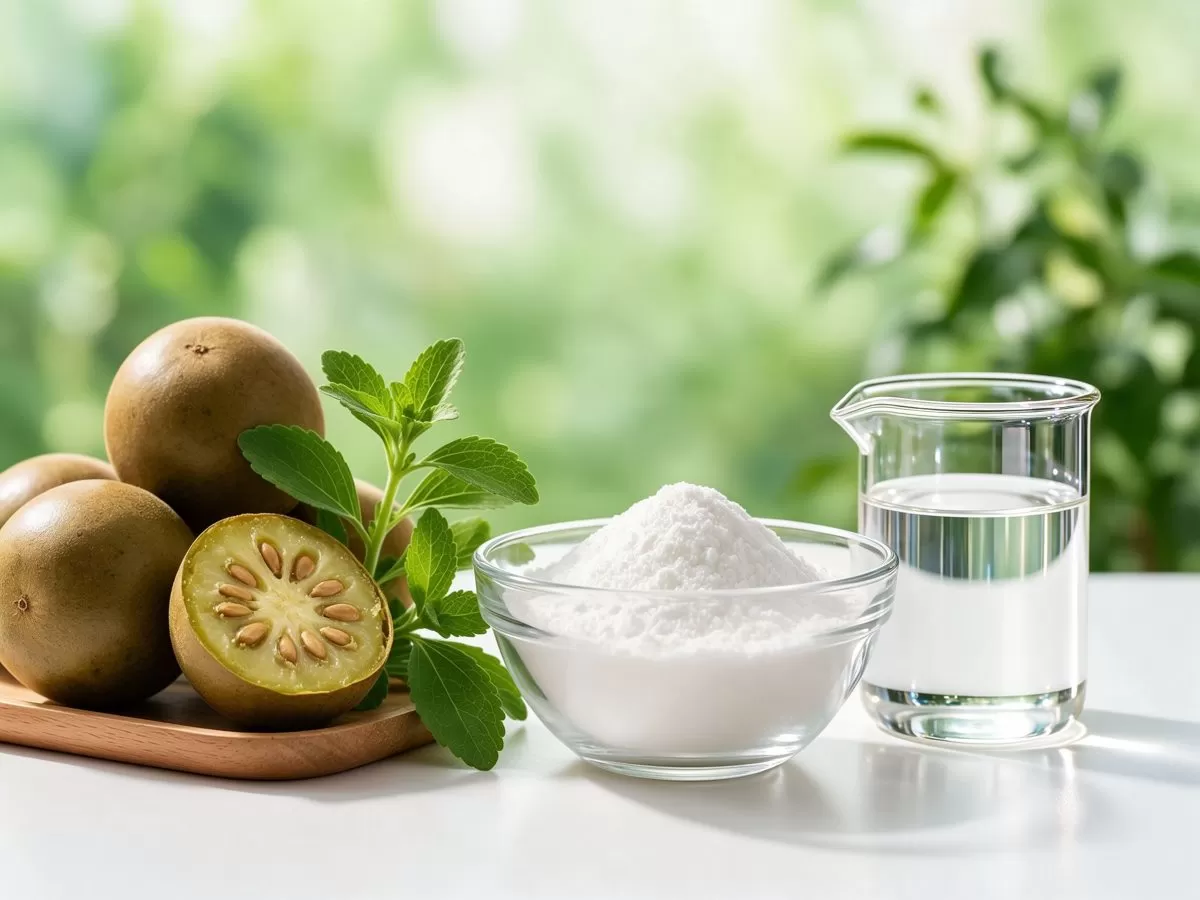
Steviol glycosides are extracted from the leaves of Stevia rebaudiana, a plant native to Paraguay and Brazil. The active compounds – primarily rebaudioside A and stevioside – deliver 200 to 300 times the sweetness of sucrose.
Best application: Low-volume applications: beverages, dairy, bakery, and any product where only a small quantity of sweetener is needed.
Key advantage: Extremely high sweetness intensity means very low usage levels, which keeps cost per serving manageable despite a high per-kilogram price. GRAS status since 2008. Widely accepted in consumer-facing marketing as a “clean label” ingredient.
Limitation: The characteristic bitter and metallic aftertaste at higher concentrations remains the single most cited consumer complaint. Modern high-purity rebaudioside blends (Reb M, Reb D) have reduced but not eliminated this issue.
Regulatory status: GRAS (U.S., 2008), approved as E960 in the EU, approved in Japan and China. EFSA established an ADI of 4 mg/kg body weight for steviol glycosides.
Monk Fruit Extract (Luo Han Guo)
Monk fruit extract is derived from the fruit of Siraitia grosvenorii, a vine native to southern China. The active compounds, mogrosides, deliver 150 to 250 times the sweetness of sucrose.
Best application: Premium beverages, functional foods, oral care products, and any application where a clean, neutral taste profile is critical.
Key advantage: Among high-intensity natural sweeteners, monk fruit has the cleanest taste profile with minimal aftertaste. Its traditional use in Chinese medicine for over 800 years provides a heritage narrative that resonates with consumers seeking “ancient superfood” positioning.
Limitation: Cost per kilogram is among the highest in the category. Production capacity is constrained by the agricultural requirements of the monk fruit vine, which is sensitive to climate and soil conditions. Yield per hectare is significantly lower than stevia.
Regulatory status: GRAS (U.S., 2010), approved in Japan and China. As of 2026, monk fruit extract remains under Novel Food evaluation in the EU and is not yet approved for general food use in the European market.
Allulose (D-Psicose)
Allulose is a rare sugar found naturally in small quantities in figs, raisins, and dried pineapple. Commercially, it is produced from fructose through enzymatic isomerization.
Best application: Bakery, ice cream, beverages, and any application where browning, caramelization, and sugar-like texture are essential.
Key advantage: Allulose is the closest functional substitute for sucrose among currently available natural sweeteners. It participates in the Maillard reaction, meaning it browns and caramelizes like sugar. It provides bulk at approximately 70% of sucrose sweetness, delivering both sweetness and texture in a single ingredient. The FDA specifically permits allulose to be excluded from “Total Sugars” and “Added Sugars” on Nutrition Facts labels, a regulatory advantage no other sweetener currently holds.
Limitation: Cost remains substantially higher than conventional sweeteners, though prices have declined as production scale increases. Regulatory status varies significantly by market – see Section V for details. Digestive tolerance at high doses (above approximately 30-40g per serving) can cause gastrointestinal discomfort in sensitive individuals.
Regulatory status: GRAS (U.S., 2019). FDA allows exclusion from sugar declarations on nutrition labels. EU Novel Food application under evaluation as of 2026 – not yet approved for general food use in the European Union. Approved in Japan and China (China approved as a new food ingredient in 2023).
Tagatose
Tagatose is a rare sugar and the structural isomer of fructose. It is found naturally in small amounts in dairy products and can be produced commercially from lactose.
Best application: Dairy products, baked goods, chocolate, and applications where near-sucrose taste and browning behavior are critical.
Key advantage: Tagatose delivers 92% of sucrose sweetness – the closest match of any currently available sweetener. It participates in the Maillard reaction and has demonstrated prebiotic fiber properties in research. Its taste profile is widely considered the most sucrose-like of all sugar substitutes.
Limitation: Cost is the highest among all natural sweeteners discussed here, making it viable primarily for premium applications. Commercial production capacity is limited. Regulatory recognition is narrower than erythritol or stevia.
Regulatory status: GRAS (U.S.). Widely recognized in food applications in Japan and several Asian markets. EU status requires case-by-case evaluation.
Quick Comparison: Sweetener at a Glance
| Sweetener | Sweetness vs Sucrose | Best For | Key Limitation | EU Status (2026) |
| Erythritol | 70% | Beverages, gum, chocolate | Cooling effect | Approved (E968) |
| Stevia | 200-300x | Low-volume applications | Bitter aftertaste | Approved (E960) |
| Monk Fruit | 150-250x | Premium beverages | High cost, limited supply | Under evaluation |
| Allulose | 70% | Bakery, ice cream | Cost, digestive tolerance | Under evaluation |
| Tagatose | 92% | Dairy, baked goods | Highest cost | Case-by-case |
Bottom line: no single sweetener dominates all applications. The industry standard is multi-sweetener blending, combining the bulk of erythritol, the intensity of stevia or monk fruit, and the functionality of allulose or tagatose.
III. The Replacement Triangle: What Formulators Actually Need to Solve
Reformulating with sugar reduction is not a substitution problem. It is a three-dimensional optimization problem.
Sugar performs sweetness, texture, and browning. When you remove sugar, you must replace all three functions – not just the sweetness. A formula that replaces sweetness but not texture will fail in the marketplace, regardless of how clean the ingredient list is.
The Blending Strategy
Because no single ingredient replaces all three functions, the default industry approach is multi-sweetener blending:
- Erythritol provides bulk and mouthfeel, compensating for the volume that sugar used to occupy.
- Stevia or monk fruit provides intense sweetness at negligible volume, keeping the formula compact.
- Allulose or tagatose provides browning capability and sucrose-like taste, closing the flavor gap.
The optimal blend ratio depends entirely on the application matrix. A carbonated beverage has different constraints than a chocolate bar, which has different constraints than a yogurt. This is why supplier technical support – not just product specifications – is a critical evaluation criterion.
Why the Evidence Chain Is the Differentiator
When evaluating sweetener suppliers, the most reliable signal is not the price per kilogram or the certified sweetness level. It is the evidence chain: per-batch COA data demonstrating consistency across marker compound content, functional performance in target matrices, and cost per serving in the finished product.
Suppliers who can provide batch-level data for all three parameters win formulation conversations. Suppliers who provide only a generic spec sheet lose them.
IV. By Application: Where Natural Sweeteners Create the Most Value
Beverages – The Highest Volume Segment
Carbonated beverages, ready-to-drink teas, and functional drinks are the largest application segments for sugar reduction. The key challenge in beverages is the cooling effect: erythritol produces a noticeable cooling sensation in carbonated drinks that many consumers find undesirable. This makes allulose-based or allulose-monk fruit blends the preferred choice for beverage reformulation.
The secondary challenge is solubility. Some high-intensity sweeteners require co-solvents or pH adjustment to dissolve completely in acidic beverage matrices. Supplier technical support that addresses solubility in your specific product system is essential.
NUTRALIGTING implication: beverage-formulation-ready extracts with documented solubility and stability data in acid systems.
Bakery and Confectionery – The Functionality Challenge
Baking presents the most complex sugar reduction challenge. Sugar contributes structure (through creaming and aeration), moisture retention (through hygroscopy), browning (through Maillard reaction), and spread (through melting point depression). Removing sugar without replacing these functions produces dense, pale, flat products.
Allulose is the strongest single-ingredient candidate for bakery applications because it browns and caramelizes. However, allulose alone does not provide sufficient bulk, which is why allulose-erythritol blends are the formulation standard for bakery reformulation.
NUTRALIGTING implication: bakery-grade allulose and monk fruit extract options with documented browning and moisture retention data.
Dairy and Frozen Desserts – The Mouthfeel Priority
In dairy and frozen desserts, sugar contributes creaminess and freezing point depression – the latter being critical for ice cream texture. Allulose and tagatose both address these functions effectively. Stevia requires careful masking of aftertaste in dairy matrices, where the fat and protein can interact with bitter compounds and amplify off-notes.
NUTRALIGTING implication: dairy-compatible sweetener blends with stability and mouthfeel data.
Functional Foods and Supplements – The Clean Label Premium
The functional food and supplement segment commands the highest clean label premium. Consumers in this category actively seek products labeled “no artificial sweeteners” and are willing to pay more for that claim. Monk fruit and stevia dominate this segment due to their clean taste profiles and strong consumer recognition.
NUTRALIGTING implication: organic-certified monk fruit and stevia extracts for premium product positioning.
V. Regulatory Landscape: What Changes in 2026 Matter for Your Market
Regulatory status is the single most important variable in natural sweetener sourcing decisions. A sweetener that is GRAS in the United States may require Novel Food authorization in the European Union, and neither status guarantees approval in Japan or China. Always verify current regulatory status for each target market before committing to a supplier.
United States (FDA)
Erythritol: GRAS. A 2023 FDA scientific communication raised questions about potential cardiovascular effects at very high intake levels. The industry response has focused on formulating below the dose thresholds associated with those findings. Erythritol remains GRAS and widely used.
Allulose: GRAS (2019). The FDA specifically permits allulose to be excluded from both “Total Sugars” and “Added Sugars” declarations on Nutrition Facts labels. This is a unique regulatory advantage that no other sweetener currently holds in the U.S. market.
Stevia (Rebaudiana glycosides): GRAS. Widely used across all beverage and food categories. EFSA ADI of 4 mg/kg body weight is the reference standard.
Monk fruit: GRAS (2010). Approved for use in all food categories.
European Union (EFSA)
Erythritol: Approved as food additive E968. Accepted throughout the EU with no recent safety concerns.
Stevia (E960): Approved. ADI established at 4 mg/kg body weight. Widely used in beverages, dairy, and table sweeteners.
Allulose: Novel Food application under EFSA evaluation as of 2026. Not yet approved for general food use in the EU. Companies importing allulose-containing products into the EU should monitor this status closely.
Monk fruit: Novel Food status. Requires EU authorization before commercial use. Not yet approved as of 2026.
Tagatose: Approved in several EU member states on a case-by-case basis. No Union-wide approval yet.
Japan (MHLW)
Erythritol, stevia, and monk fruit all have long-standing approval as food ingredients. Japan remains one of the most advanced markets for sugar reduction innovation, with allulose also approved and widely used in confectionery and beverage applications. Japanese consumers have accepted sugar-reduced products for longer than most other markets, providing a useful leading indicator for broader regional adoption trends.
China (NHC)
Erythritol, stevia, and monk fruit all have long-standing approval as food additives in China. China is both a major producer and consumer of natural sweeteners, with domestic production of stevia and monk fruit extract supplying both the domestic market and international export.
Allulose: Approved as a new food ingredient in 2023. This approval opened a significant domestic market for allulose applications in China.
The Sourcing Question: What Makes a Natural Sweetener Supplier Different
When evaluating natural sweetener suppliers, formulators and procurement teams should assess six dimensions. The following framework distinguishes suppliers who can support complex formulation challenges from those who can only supply commodity-grade ingredients.
| Evaluation Dimension | Strong Signal | Weak Signal |
| Batch consistency | COA with +/-3% tolerance on marker compound; HPLC-verified per batch | Generic spec sheet without batch-specific data |
| Source traceability | Origin documentation (farm/region), harvest timing records, varietal identification | No origin information or varietal specification |
| Application support | Technical data sheets with solubility, stability, and compatibility data in target matrices | Only general product specification, no application guidance |
| Regulatory documentation | Full COA package: heavy metals (USP/EP), pesticides (EU/FDA limits), microbiological, solvent residue | Basic assay only, no comprehensive safety testing |
| Certifications | Organic (USDA NOP and/or EU Organic), Kosher, Halal, ISO 22000 | No third-party certifications or only basic quality certifications |
| Customization capability | Willing to adjust extraction ratio, particle size, blend composition, and packaging per client specification | Fixed SKU only, no flexibility on specifications |
The suppliers who consistently win long-term formulation partnerships are those that provide batch-level evidence across all six dimensions, not just the cheapest per-kilogram price.
VII. FAQ: What Formulators Ask About Sugar Reduction
What is the best natural sweetener for sugar reduction in 2026?
No single sweetener is optimal across all applications. The industry standard is multi-sweetener blending: erythritol for bulk, stevia or monk fruit for sweetness intensity, and allulose for functionality (browning and mouthfeel). The optimal blend depends on your specific product category, target market regulations, and cost constraints. There is no universal best – only the best combination for your application.
Is allulose safe? What does the FDA say?
The FDA granted allulose GRAS status in 2019. Importantly, the FDA allows allulose to be excluded from both “Total Sugars” and “Added Sugars” declarations on Nutrition Facts labels – a regulatory advantage that no other sweetener currently holds. As of 2026, allulose remains GRAS in the United States. In the European Union, allulose is still under Novel Food evaluation and is not yet approved for general food use. Always verify current regulatory status for your specific target market before committing to an allulose-based formulation.
Why do sugar-free products sometimes taste different even when they use the same sweetener?
Sugar performs three functions in food: sweetness, texture (bulk and mouthfeel), and Maillard browning (color and flavor development). Replacing only the sweetness function without addressing texture and browning creates a taste gap that consumers detect immediately, even if the sweetener dosage is correct. This is why multi-functional sweetener systems – particularly those incorporating allulose or tagatose alongside high-intensity sweeteners – consistently outperform single-sweetener approaches in consumer testing.
How much more do natural sweeteners cost compared to regular sugar?
Natural sweeteners range from approximately 3x to 20x the cost of sucrose per kilogram, depending on the ingredient. Erythritol is the most cost-effective at roughly 3-5x sucrose. Stevia and monk fruit fall in the middle range. Allulose and tagatose are premium ingredients at roughly 10-20x sucrose. However, because high-intensity sweeteners like stevia and monk fruit are used at very low doses (parts per million range), the per-serving cost impact is often significantly lower than the raw material price suggests. A complete cost-per-serving analysis – not just cost-per-kilogram – is essential for accurate budgeting.
Can natural sweeteners meet clean label requirements?
Yes, and this is precisely why the market is growing. Ingredients labeled as “stevia leaf extract,” “monk fruit extract,” or “erythritol” are generally perceived by consumers as cleaner alternatives to synthetic sweeteners like aspartame or sucralose. For organic-certified products, USDA NOP and EU Organic certified sweetener options are available from select suppliers. The key is verifying that the supplier’s certification covers the full supply chain – from raw material source through extraction and final product packaging.
VIII. Next Steps: How to Evaluate Natural Sweetener Suppliers
If you are a formulator or procurement decision-maker evaluating natural sweetener suppliers, follow this five-step process:
- Define your product requirements first. Document the target sweetness level, application matrix (beverage, bakery, dairy, or supplement), target market(s) with their regulatory requirements, and clean label standards. This document becomes the baseline against which all supplier proposals are evaluated.
- Request per-batch COA data. Do not accept generic specification sheets. Verify that marker compound content, heavy metals, pesticides, and microbial limits are tested on every batch, not just during initial qualification. Batch-to-batch consistency is the single strongest predictor of formulation reliability.
- Test in your actual formulation. Supplier samples should be evaluated in your product system, not in water or a standard test matrix. Compatibility, solubility, and stability in your specific pH, temperature, and ingredient environment are the only data that matter.
- Verify regulatory compliance for each target market. Confirm GRAS, Novel Food, or equivalent status for every sweetener in your formulation before committing to a supplier. Regulatory status can change – monitor EFSA, FDA, and NHC updates quarterly.
- Evaluate the supplier’s technical support depth. The suppliers who earn long-term partnerships are those that provide application-specific guidance, not just product specifications. Ask about their experience with your product category, their ability to customize blend ratios, and their track record with clients in your market.
IX. Sources and References
Persistence Market Research. “Natural Sweeteners Market – Global Industry Analysis and Forecast 2026-2033.” Base year: 2026. Forecast period: 2026-2033. CAGR: 6.2%.
U.S. Food and Drug Administration (FDA). GRAS Notices: Erythritol, Stevia Rebaudiana Glycosides, Monk Fruit Extract, and Allulose. FDA GRAS Notice Database. Accessed October 2026.
European Food Safety Authority (EFSA). Scientific Opinion on the revision of the acceptable daily intake for steviol glycosides (E960). EFSA Journal. 2015;13(5):4106. Current status reviewed 2026.
European Food Safety Authority (EFSA). Novel Food catalog – Allulose and Monk Fruit Extract entries. EFSA Panel on Dietetic Products, Nutrition and Allergies (NDA). Assessment ongoing as of 2026.
Japan Ministry of Health, Labour and Welfare. Standards for Use of Food Additives and Natural Sweeteners. 2024 edition.
China National Health Commission (NHC). Announcement on the Approval of Allulose as a New Food Ingredient (2023 No. 3). GB 2760-2024 Standards for Uses of Food Additives.
FDA. Guidance for Industry: Labeling of Added Sugars on the Nutrition and Supplement Facts Label. U.S. Food and Drug Administration. 2024.
OECD. Test No. 423: Acute Oral Toxicity – Acute Toxic Class Method. OECD Guidelines for the Testing of Chemicals. 2017.
NUTRALIGTING Internal Quality Control Data. Batch Consistency Reports. 2025-2026.
X. Partnering With NUTRALIGTING
NUTRALIGTING is a plant extract manufacturer specializing in standardized natural sweetener ingredients. Our product portfolio includes monk fruit extract (luo han guo), stevia extract, and allulose – each available with full per-batch COA documentation, organic certification, and ISO/HALAL compliance.
We serve food and beverage manufacturers across North America, Europe, Japan, Southeast Asia, the Middle East, and South Asia. If you are evaluating natural sweetener options for your next product development cycle, we recommend starting with a technical data sheet and a sample batch for in-house testing.
Contact us for product specifications, regulatory documentation, and formulation support.