Product Description
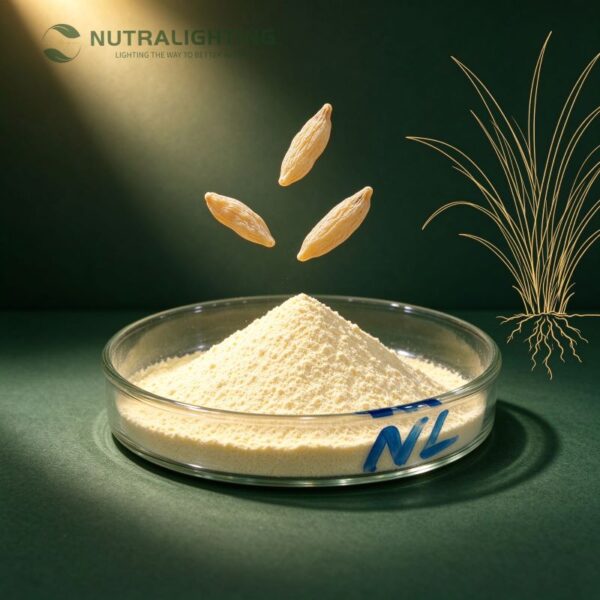
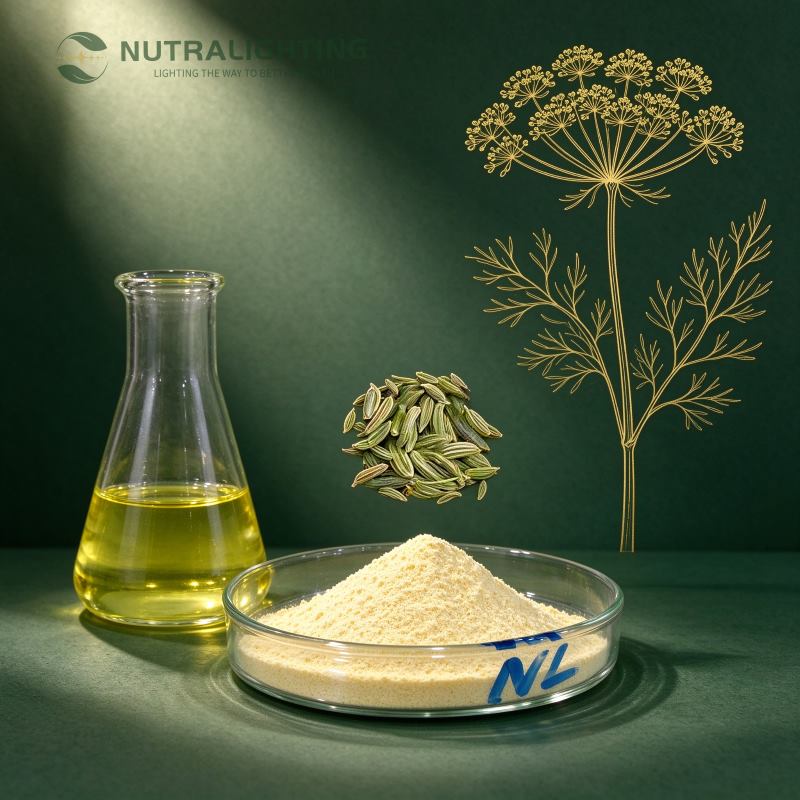
Nutralighting offers premium Fennel Extract, a natural botanical ingredient derived from the fruits of Foeniculum vulgare. Our extract delivers consistent levels of anethole, fenchone, and essential oils – widely used in food & beverage flavoring, herbal supplements, and functional ingredient formulations.
Basic Information
| Item | Content |
|---|---|
| Product Name | Fennel Extract |
| Botanical Source | Foeniculum vulgare Mill. |
| Plant Family | Apiaceae (Umbelliferae) |
| Part Used | Dried mature fruit (cremocarp) |
| Primary Actives | trans-Anethole, fenchone, estragole, flavonoids, phenolic compounds |
| Appearance | Light yellow to light brown fine powder |
| Characteristic Odor | Sweet, anise-like aroma |
| Extraction Solvent | Water or food-grade ethanol |
| Standard Specifications | 10:1 and 20:1 extract ratios (ratio product) |
| Marker Verification | trans-Anethole identified by GC; total polyphenols and total flavonoids by spectrophotometry |
| CAS (Marker Compound) | trans-Anethole: 4180-23-8 (the extract itself has no single CAS number) |
| Origin | Cultivated in Inner Mongolia and Gansu, China |
| Shelf Life | 24 months in sealed, cool, dry storage |
| Target Market | Dietary supplements, herbal teas, functional foods, flavoring ingredients, cosmetics |
| Core Application Areas | Digestive comfort and bloating support, traditional carminative use, natural flavoring, antioxidant support |
Product Description
Fennel Extract comes from the dried ripe fruit of Foeniculum vulgare Mill. This plant belongs to the Apiaceae family. The fruit is a well-known spice and a recorded Chinese medicinal material. It appears in the Chinese Pharmacopoeia under the name Xiao Hui Xiang (Fructus Foeniculi).
The sweet anise-like aroma comes mainly from trans-anethole. The fruit also holds fenchone, estragole, flavonoids and phenolic compounds. Fennel is sometimes confused with star anise, but the two are different plants. Star anise (Illicium verum) belongs to the Schisandraceae family. Fennel fruit is smaller and forms in clusters on an umbellifer. Both contain anethole, yet their botanical origins are entirely different.
Our extract is produced from selected fennel fruit using water or food-grade ethanol. The powder is concentrated at a 10:1 or 20:1 fruit-to-extract ratio. Each batch is checked for the characteristic anethole peak by GC. Total polyphenols and total flavonoids are measured as quality verification markers. The powder blends easily into teas, tablets, capsules and flavor systems.
Active Constituents
The aroma and traditional role of fennel fruit are linked to its volatile oil and its phenolic fraction. The table below lists the main constituents we monitor.
| Constituent | CAS | Formula | Molecular Weight |
|---|---|---|---|
| trans-Anethole (main aromatic) | 4180-23-8 | C10H12O | 148.2 |
| Anethole isomers & estragole | – | – | – |
| Fenchone & fenchol (monoterpenes) | – | – | – |
| Total polyphenols (Folin-Ciocalteu) | – | – | – |
| Total flavonoids (NaNO2-AlCl3) | – | – | – |
Certificate of Analysis (Typical Specification)
| Item | Specification | Method | Result Range |
|---|---|---|---|
| Appearance | Light yellow to brown powder | Visual | Conforms |
| Odor & Taste | Characteristic sweet fennel aroma | Organoleptic | Conforms |
| Mesh Size | 80 mesh | Sieve test | ≥95% pass |
| Moisture | ≤5.0% | Gravimetric | ≤5.0% |
| Total Ash | ≤5.0% | Gravimetric | ≤5.0% |
| Lead (Pb) | ≤5.0 ppm | ICP-MS | ≤5.0 ppm |
| Arsenic (As) | ≤2.0 ppm | ICP-MS | ≤2.0 ppm |
| Cadmium (Cd) | ≤1.0 ppm | ICP-MS | ≤1.0 ppm |
| Mercury (Hg) | ≤0.2 ppm | ICP-MS | ≤0.2 ppm |
| Total Aerobic Count | ≤10,000 CFU/g | Plate count | Conforms |
| Yeast & Mold | ≤1,000 CFU/g | Plate count | Conforms |
| E. coli | Negative | MPN method | Negative |
| Salmonella | Negative in 25 g | Culture method | Negative |
| trans-Anethole | Characteristic peak present | GC | Identified |
| Total Polyphenols | Reported per batch | Folin-Ciocalteu | As stated on COA |
| Total Flavonoids | Reported per batch | NaNO2-AlCl3 | As stated on COA |
| Shelf Life | 24 months | Stability storage | Conforms |
Mechanism of Action
Evidence for fennel draws on traditional use, laboratory studies and animal research. Clinical data remain limited. The points below describe the working hypotheses behind its uses.
Smooth muscle relaxation: anethole and the volatile oil ease gastrointestinal muscle tone in laboratory models. This spasmolytic activity matches the traditional carminative use of the fruit.
Gas and bloating: traditional systems hold that fennel helps release trapped gas and eases abdominal tension. The aromatic compounds are considered the active drivers.
Digestive secretions: folk practice suggests fennel supports gastric juice and bile flow. Modern confirmation of this effect is still limited.
Antioxidant activity: flavonoids and phenolic compounds scavenge free radicals in test-tube assays. This supports the fruit’s traditional role as a protective food.
Hormonal note: anethole shows weak estrogen-like activity in cell studies. These findings are preliminary and are not clinical proof of any effect.
Traditional and Modern Use
Traditional Use
In Chinese medicine, fennel fruit warms the middle burner and disperses cold. The Pharmacopoeia records its functions as dispersing cold, relieving pain, moving qi and harmonizing the stomach. Typical decoction doses of the raw fruit run 3-6 g per day. European herbal traditions valued fennel as a carminative after meals. Historic gripe preparations used fennel water for infant discomfort. In India, roasted fennel seeds are chewed after meals as mukhwas, a traditional mouth freshener and digestive.
Modern Applications
Today the fruit and its extracts flavor teas, liqueurs, bakery goods and confectionery. Digestive comfort blends pair fennel with ginger, chamomile or caraway in capsules and tablets. The sweet anise note serves flavorists in oral care and beverage formulas. Aromatherapy and personal care lines use fennel oil as a perfuming ingredient. Research continues on anethole, the antioxidant fraction and traditional digestive claims.
Regulatory Status
| Region | Status | Notes |
|---|---|---|
| China | Food-medicine homology spice; Pharmacopoeia-listed material | Included in the 2002 Ministry of Health Notice No. 51 list of items that are both food and Chinese medicine; fruit recorded in the Chinese Pharmacopoeia (Xiao Hui Xiang) |
| European Union | Traditional culinary spice and flavoring | Not a novel food; anethole is evaluated as a flavoring substance under EU flavouring legislation |
| United Kingdom | Common food spice | Long traditional culinary use |
| United States | DSHEA dietary supplement ingredient; FEMA GRAS flavoring | trans-Anethole (CAS 4180-23-8) is recognized as a GRAS flavoring substance |
| Japan & South Korea | Accepted food spice | Used in teas and flavoring systems |
| India & Australia/NZ | Traditional food ingredient | Roasted seeds used as mukhwas; conventional spice status |
Recommended Usage
The Chinese Pharmacopoeia lists a daily dose of 3-6 g of fennel fruit for decoction use.
A 10:1 extract converts that fruit dose to roughly 300-600 mg per day. A 20:1 extract converts to about 150-300 mg per day.
In foods and beverages, dose according to flavor target and formulation design.
These figures are for general reference only. Follow product label directions and applicable local regulations.
Precautions
General Precautions
Pregnant or breastfeeding women: culinary amounts have a long food history. Supplement-level dosing has limited safety data. Consult a qualified professional before use.
Children: fennel tea has a folk history for infant colic. Give it only under professional guidance.
Allergy alert: fennel belongs to the Apiaceae family. People allergic to celery, carrot or dill may cross-react. Avoid use if you have such allergies.
Drug Interactions
Clinical interaction data are limited. Cell studies show weak estrogen-like activity from anethole, so theoretical caution applies to hormone-sensitive therapy.
Talk to a healthcare professional if you take prescription medicines on a regular basis.
Contraindications
Do not use with known hypersensitivity to fennel or anethole. People with hormone-sensitive conditions should consult a physician before supplemental use.
Do not exceed the recommended dose. High-dose fennel oil is not advised for self-use.
When to Discontinue
Stop use if rash, nausea or abdominal discomfort appears. Seek medical advice if symptoms persist.
Consider pausing supplemental use before scheduled surgery and inform your physician.
Why Choose Nutralighting
Need a true food-grade fennel powder?
We supply 10:1 and 20:1 ratios made from Pharmacopoeia-listed fennel fruit.
Looking for batch-level transparency?
Every lot ships with a COA covering anethole identity, heavy metals and microbiology.
Require a consistent aroma profile?
GC checks keep the sweet anethole note stable across batches.
Want flexible formulation support?
Our team helps match ratio, mesh and solvent to your tea, capsule or flavor system.
Concerned about supply continuity?
We source from established fennel-growing regions in northern and northwestern China.
Planning a private-label digestive blend?
Samples, documentation and custom packaging are ready for your launch.
References
Chinese Pharmacopoeia Commission. Pharmacopoeia of the People’s Republic of China, 2020 Edition, Volume I. Entry: Xiao Hui Xiang (Fructus Foeniculi), Foeniculum vulgare Mill. China Medical Science Press, 2020.
Ministry of Health of the People’s Republic of China. Notice Concerning the Management of Items That Are Both Food and Chinese Medicinal Materials (Weishengfa [2002] No. 51), 2002.
National Center for Biotechnology Information. PubChem Compound Summary for Anethole, trans- (CAS 4180-23-8). https://pubchem.ncbi.nlm.nih.gov/
European Parliament and Council of the European Union. Regulation (EC) No 1334/2008 on flavouring substances and certain food ingredients with flavouring properties. Official Journal of the European Union, 2008.
Nutralighting internal supplier specifications and batch COA records for Fennel Extract 10:1 / 20:1.
El-Sayed, N. M., et al. Phytochemical screening, phenolic content, and anti-inflammatory effect of Foeniculum vulgare seed extract. Journal of Ethnopharmacology, 2022, 293: Article 115276. DOI: 10.1016/j.jep.2022.115276.
Omer, N. A., et al. Evaluation of the hypoglycemic activity of methanolic extract of Foeniculum vulgare in streptozotocin-induced diabetic Wistar rats. Journal of Diabetes Research, 2023, 2023: Article 5578923. DOI: 10.1155/2023/5578923.
Kaur, R., et al. Recent advances in extraction, characterization and food applications of Foeniculum vulgare bioactive compounds. Trends in Food Science & Technology, 2024, 147: 245-259. DOI: 10.1016/j.tifs.2024.03.018.
Frequently Asked Questions
Fennel Extract is produced via solvent or water extraction yielding a concentrated powder or liquid containing both volatile and non-volatile constituents. Fennel Essential Oil is obtained solely by steam distillation and is richer in anethole and fenchone but lacks the water-soluble polysaccharide fraction found in extracts.
Standard lead time is 15-25 working days after order confirmation and payment receipt. Express samples (1 kg) can be shipped within 3-5 days.
Absolutely. We offer OEM/ODM services including custom extract ratios, particle size, packaging, and labeling. Minimum order quantity applies for customized runs.
Fennel Extract is generally recognized as safe (GRAS) in approved dosage ranges. However, we recommend verifying usage levels against local regulations (FDA, EFSA) and consulting toxicology data before formulation in pediatric products.
Packaging & Shipping
Standard Packaging
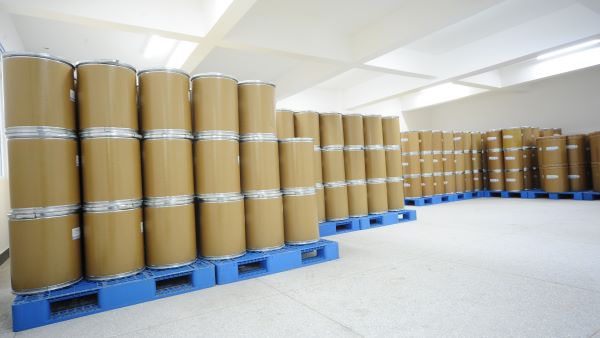
- Standard: 25 kg fiber drum with double PE liner inner bag.
- Custom: 1 kg aluminum foil bag, 5 kg cardboard box, or customer-requested packaging.
- All packages labeled with product name, batch number, manufacturing date, and expiry date.
Shipping Terms
- Express (DHL/FedEx/TNT): 3-7 days for samples and small orders.
- Air freight: 5-10 days for bulk shipments to major international airports.
- Sea freight: 25-40 days depending on destination port.
- FOB Shanghai / CIF / DDP terms available.
Shelf Life & Storage
- Store in a cool, dry place away from direct sunlight and heat sources.
- Keep containers tightly sealed when not in use.
- Recommended storage temperature: 2°C – 8°C for liquid extract; 15°C – 25°C for powder form.