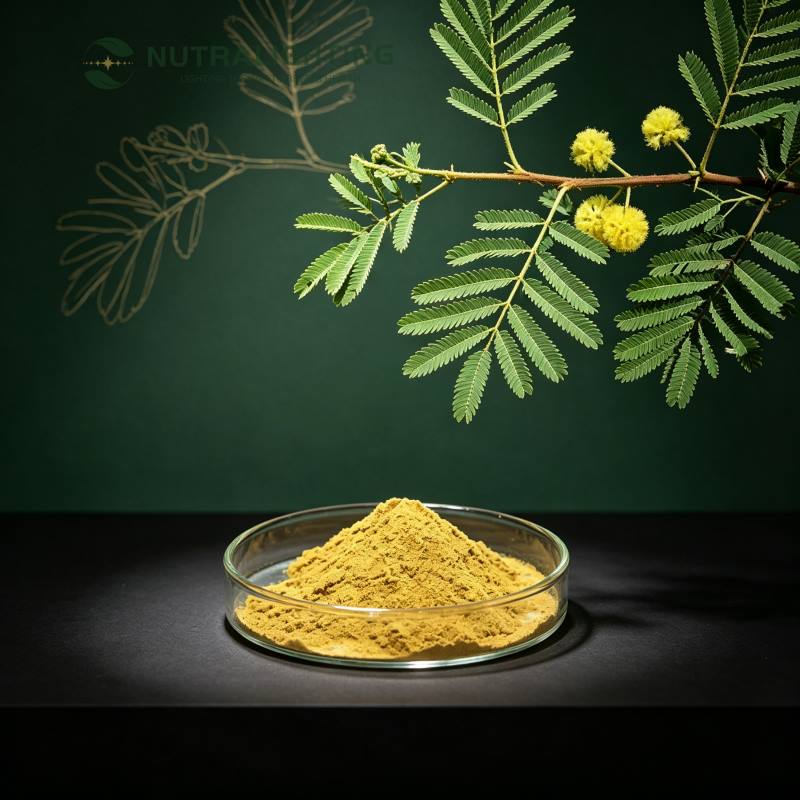
Product Description
Refined from Acacia bark and gum, standardized to 20%-40% tannins – a specialty plant ingredient for astringent, oral care, and gut health applications.
Product Description
The demand for plant tannins and gums with clear origin and stable specifications continues to grow in oral care, gut health, and food industry gel applications. Acacia extract, made from bark and gum, enriches and standardizes tannins, providing a versatile ingredient with both astringent and gelling properties for formulations.
Acacia Extract is made from Acacia (Acacia nilotica) bark and gum, extracted and refined at low temperature, with core active components of tannins, gallic acid, and Arabic gum. Tannins are standardized at 20%-40% (tannic acid ≥30%). It is widely used in oral care, gut health, and food industry gel applications, serving as a versatile plant ingredient with both astringent and gelling properties.
Acacia extract has been widely used in traditional medicine in Africa and India.
Product quality is controlled according to USP / EP pharmacopeia standards. Each batch comes with a Certificate of Analysis (COA), covering key indicators such as characteristic component content, loss on drying, ash, heavy metals (Pb, As, Cd, Hg), pesticide residues, aflatoxins, and microorganisms. Different extraction ratios and standardized specifications can be customized according to customer requirements.
Why Choose Nutralighting
Clear Specifications: Tannins standardized at 20%-40%, tannic acid ≥30%, with stable and customizable batches.
Multi-Scenario Adaptability: Combines astringent (oral/gut) and food industry Arabic gum sources, suitable for multiple dosage forms.
Basic Information
| Item | Content |
| Product Name | Acacia Extract |
| Other Names | Acacia Arabica Extract / Babool Extract / Gum Arabic / E414 |
| Main components | Tannin, gallic acid, arabic gum |
| Main specifications | Tannin 20%-40% |
| Target markets | Middle East, Africa, Europe |
| Core application areas | Gut Health; Oral Care; Antioxidant |
Standard Specifications (COA)
The following specifications are conventional reference values; the actual values are subject to the acacia extract COA report of each batch.
| Test Items | Standards |
| Tannins | Tannins 20%-40% |
| Loss on Drying | ≤5.0% |
| Total Ash | ≤6.0% |
| Lead (Pb) | ≤1.0 mg/kg |
| Arsenic (As) | ≤2.0 mg/kg |
| Cadmium (Cd) | ≤0.5 mg/kg |
| Mercury (Hg) | ≤0.1 mg/kg |
| Pesticide Residues (Organochlorine/Organophosphate) | Complies with USP <561> |
| Aflatoxin B1 | ≤5.0 μg/kg |
| Total Aflatoxins | ≤10.0 μg/kg |
| Total Microbial Count (TAMC) | ≤1×10⁴ CFU/g |
| Yeasts and Molds (TYMC) | ≤1×10² CFU/g |
| Escherichia coli | Not detected (1g) |
| Salmonella | Not detected (1g) |
Introduction of Plant Material
The raw material of acacia extract is the dried bark and gum of the leguminous plant Acacia nilotica (L.) Willd. ex Delile. It is mainly produced in Africa (Sudan, Somalia, Chad) and India. Acacia gum (Arabic gum) is one of the most important natural plant gums worldwide. The bark contains a high concentration of tannins. The main active components are tannins (content up to 40-50%) and Arabic gum polysaccharides.
Core Functions
The following overview of functions is based on published scientific research and traditional applications. Specific functions should be evaluated in combination with product form and dosage.
Traditionally, its astringent properties have been applied long-term in gastrointestinal health and oral care; in vitro studies show that the extracts can inhibit various common oral and intestinal bacteria.
As a soluble dietary fiber, Arabic gum is also supported by research for gut microbiota modulation and stabilization of postprandial blood sugar.
Specific effects should be comprehensively evaluated according to product form, dosage, and applicable regulations. This information does not constitute any medical or disease treatment claims.
Regulatory and Regional Access Status
The following information is compiled based on publicly available regulatory data. Actual market access should be based on the latest regulations of the target country.
| Region/Country | Regulatory Status | Key Notes |
| European Union (EFSA) | Traditional Herbal Medicine / Food Supplement | EU Directive 2004/24/EC regulates traditional herbal medicines; extracts used as ingredients in food supplements must comply with EU Novel Food Regulation (EU) 2015/2283 requirements (some traditional herbs enjoy a simplified procedure). |
| China (NHC/NMPA) | Health Food Ingredients / New Resource Foods | According to the 2020 edition of the Chinese Pharmacopoeia and standards such as GB 16740; some varieties have been included in the catalog of health food ingredients or can be used in ordinary foods, and the latest regulatory status of each variety needs to be specifically verified. |
Note: Regulatory information is time-sensitive. Before export, it is recommended to confirm the latest compliance requirements with the regulatory authorities of the target market or professional consultants.
Application Directions and Recommended Dosage
| Application Direction | Recommended Dosage | Applicable Dosage Forms | Remarks |
| Daily Nutritional Supplement | Determined According to Specifications | Taken Before or After Exercise | Can be used as a daily dietary supplement formula |
| Oral solid beverage / granules | According to specifications | Stick pack, bag, can | Can be combined with other functional ingredients, recommended to control the amount with standardized extracts |
| Compressed candy / capsule | According to specifications | Tablet, hard capsule | Each capsule is recommended to contain 250~500 mg of extract, 2~3 times daily |
| Oral liquid / functional beverage | According to specifications | Glass bottles, PET bottles | It is recommended to disperse in warm water first before adding to the system, paying attention to pH stability |
| Personal care skincare products | 0.1~2.0%(w/w) | Lotion, serum, mask | Solubility and stability need to be evaluated according to the formulation system |
Recommended Daily Dosage Reference
- General Health Use: Use according to product specifications and the dosage recommended by the formulator
- Personal Care and Skincare: The amount added in formulations depends on the specific product, recommended 0.1~2.0%
Other Notes
- Acacia Extract is a plant-derived product; some individuals may experience allergic reactions. It is recommended to start with a small dose for first-time use.
Take Action Now
Whether you are developing oral care, gut health, or food industry gelling applications, Nutralighting can provide Acacia Extract solutions ranging from standard specifications to OEM/ODM customization, complete with full technical data packages (TDS / COA / MSDS) and regulatory consultation.
Contact us now to get samples and quotes, and start upgrading your formulations.
(Note: End product claims must comply with the regulations of the sales location. It is recommended to confirm the latest compliance requirements with regulatory authorities in target markets.)
Appendix: References
(The following literature is for technical reference. Some are open access and can be accessed through PubMed/PMC or journal websites)
[1] Rowland I.R. et al., British Journal of Nutrition, 2012; 107: 1797-1804.
[2] Gidley M.J. et al., Current Opinion in Colloid and Interface Science, 2015; 20: 219-229.
[3] Sanchez-Mata M.C. et al., Journal of Agricultural and Food Chemistry, 2008; 56: 7077-7083.
Frequently Asked Questions
Acacia Extract and Gum Arabic refer to the same botanical ingredient derived from Acacia tree exudates. Gum Arabic is the common commercial name, while Acacia Extract is the broader terminology used in botanical ingredient trading.
Yes. Acacia Extract is 100% plant-derived and naturally free from gluten, dairy, nuts, and common allergens, making it suitable for vegan and allergen-sensitive product lines.
Standard MOQ is 25 kg per bag. Smaller trial quantities may be available upon request. Please contact our sales team for details.
Yes, we offer customized specifications including mesh size (40–80 mesh), concentration levels, and moisture content based on client requirements. OEM and private-label services are also available.
Packaging & Shipping
Standard Packaging
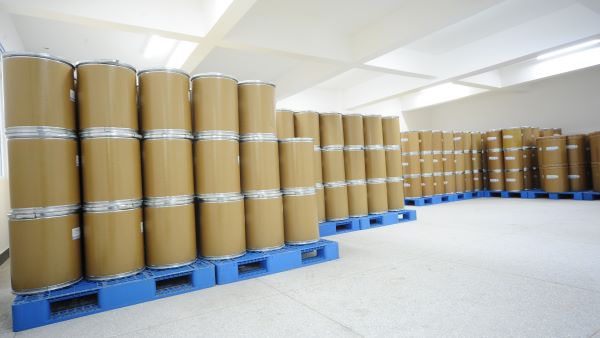
- Standard packaging: 25 kg/fiber drum with double PE liner.
- Custom packaging available: 1 kg, 5 kg, 10 kg bags or cartons.
- Private labeling and OEM packaging supported.
Shipping Terms
- Shipped via express (DHL, FedEx, UPS), air freight, or sea freight depending on order volume.
- Delivery time: 7–15 working days (express); 15–30 working days (air); 30–45 working days (sea).
- Samples available within 3–5 working days.
Shelf Life & Storage
- Store in a cool, dry place away from direct sunlight and moisture.
- Keep container tightly sealed when not in use.
- Avoid temperatures above 40°C to prevent caking or degradation.