Product Description
Barberry Extract is a premium botanical ingredient derived from the bark and root of Berberis vulgaris L. and related species. It is widely used as a standardised extract rich in berberine alkaloids, offering a versatile solution for nutraceuticals, dietary supplements, functional foods, and pharmaceutical applications.
Product Description
Nutraligting supplies Barberry Extract from the dried fruits of Berberis vulgaris L. (Family: Berberidaceae). Our raw material comes from cultivated bases in Gansu and Ningxia provinces in Northwest China. Our standard product is standardised to a minimum of 5.0% total alkaloids. We express this as berberine by HPLC. The active alkaloid fraction includes berberine, palmatine, and tetrahydropalmatine. Berberine is the primary bioactive constituent. It is responsible for the product’s metabolic and antimicrobial effects. This extract is designed for formulators who build blood-sugar-support and lipid-management dietary supplements. We serve the global B2B market.
Berberis vulgaris is commonly known as common barberry or European barberry. It is a deciduous thorny shrub. It is native to Europe, Western Asia, and North Africa. The fruit is small, elongated, and bright red when ripe. It has a characteristic sour taste. In Persia and Central Asia, barberry fruit (zereshk) is widely used as a culinary spice. It is also used as a traditional remedy. The pharmacologically active compounds are isoquinoline alkaloids. Berberine (CAS 2086-83-1) is the most abundant and best studied. Berberine content in B. vulgaris fruit typically ranges from 5.0% to 7.7% on a dry weight basis.
Berberine works mainly by activating AMP-activated protein kinase (AMPK). AMPK is a key regulator of cellular energy. AMPK activation improves insulin sensitivity. It also enhances glucose uptake in muscle and fat tissue. In addition, it inhibits hepatic gluconeogenesis. Berberine upregulates LDL receptor expression on liver cells. This leads to increased clearance of LDL cholesterol from the blood.
Clinical evidence for metabolic benefits comes from multiple RCTs and meta-analyses. A landmark meta-analysis of 14 RCTs (Yin et al., Metabolism, 2012) found that berberine significantly reduced fasting blood glucose, 2-hour postprandial glucose, and HbA1c. The effect size was comparable to metformin. Another meta-analysis (PubMed, 2023; PMC12155967) covering B. vulgaris and B. integerrima showed significant reductions in body weight, BMI, total cholesterol, LDL cholesterol, and triglycerides in type 2 diabetic patients. The usual recommended dose of berberine in clinical studies is 500 mg two to three times daily. This equals 900-1,500 mg per day of standardised barberry extract.
From a regulatory perspective, B. vulgaris fruit is listed in the FDA EAFUS database (CAS 94204-54-5). It is generally recognised as safe for use in dietary supplements under DSHEA. It is NOT GRAS-approved as a food additive. The FDA has not approved berberine or barberry extract as a drug for any indication. EFSA is currently reviewing the safety of berberine-containing plant preparations. A draft opinion was published in May 2026 (TOX-2026-14). The draft raises concerns about potential genotoxicity at high doses. Formulators targeting the EU market should be aware of these evolving considerations.
Our extraction process uses acidic ethanol-water solutions. This selectively recovers the berberine alkaloid fraction from dried barberry fruits. The extract is concentrated under reduced pressure and spray-dried. We offer standard grades at 5.0% total alkaloids (expressed as berberine). Higher-alkaloid grades are available for qualifying orders. All processing aids and solvents are food-grade.
Basic Information
| Item | Content |
| Extract Name | Barberry Extract |
| Botanical Name | Berberis vulgaris L. |
| English Common Name | Berberis vulgaris Extract, Barberry Fruit Extract |
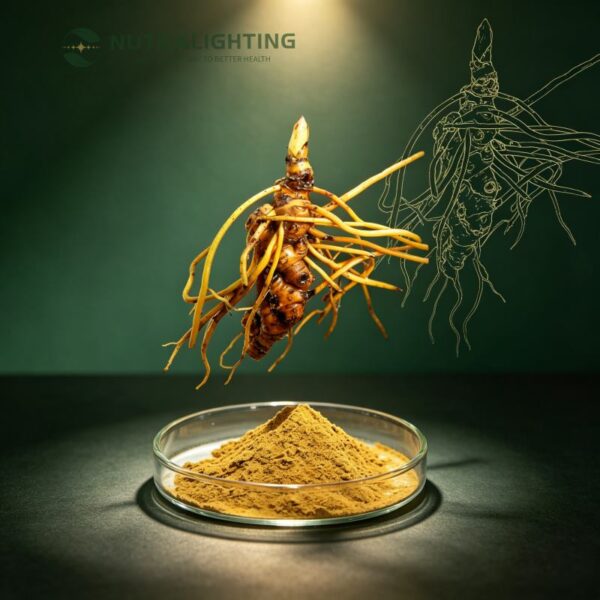
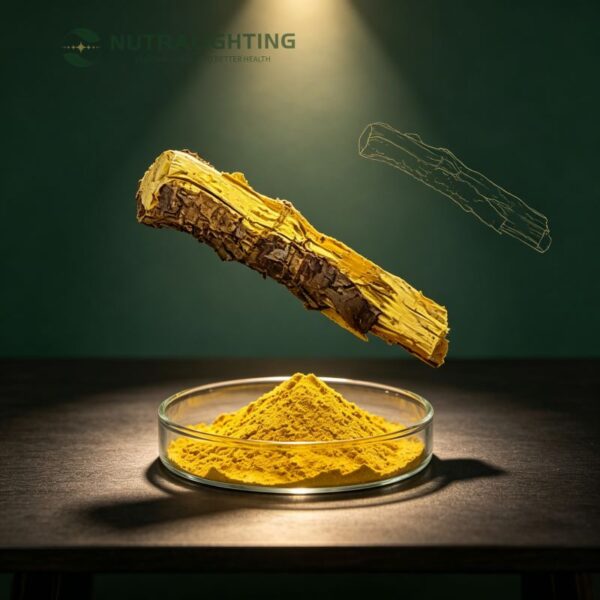
| Part Used | Bark/Root Bark |
| Main Active Components | Berberine, Palmatine, Tetrahydropalmatine, Jatrorrhizine, Columbamine |
| Key Specifications | Total Alkaloids >=5.0% (HPLC, expr. as berberine); individual alkaloid profile declared 97% / 98% / 99% (custom specifications available) |
| Extraction Solvent | Ethanol /Water |
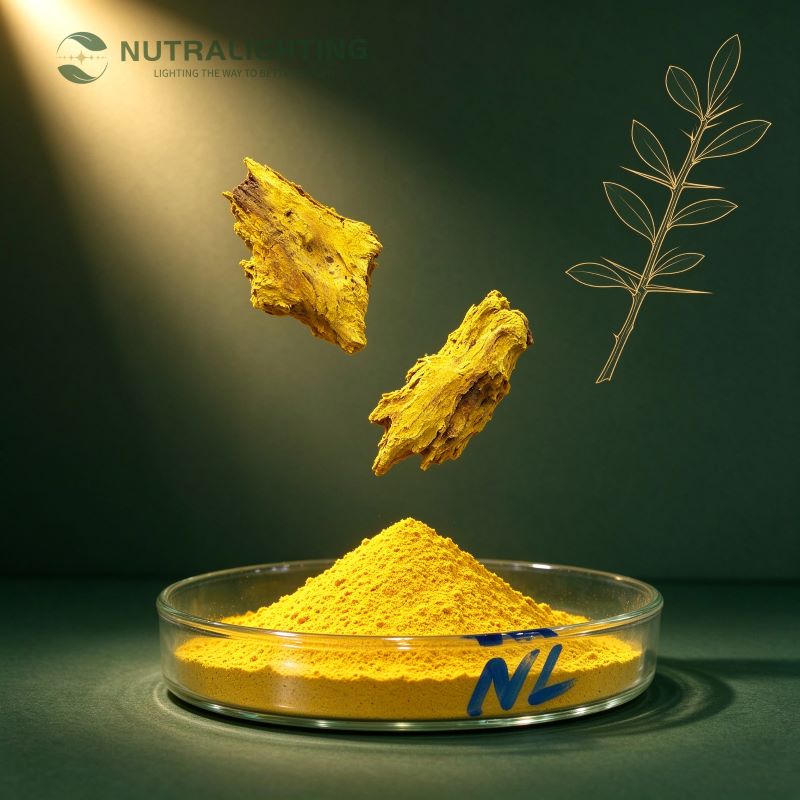
| Appearance | Fine powder, yellow to brownish-yellow |
| Odor | Characteristic |
| Taste | Bitter |
| Target Markets | North America, Europe, Asia-Pacific – Blood Sugar Support, Lipid Management segments |
| Core Application Areas | Dietary supplements; Functional foods |
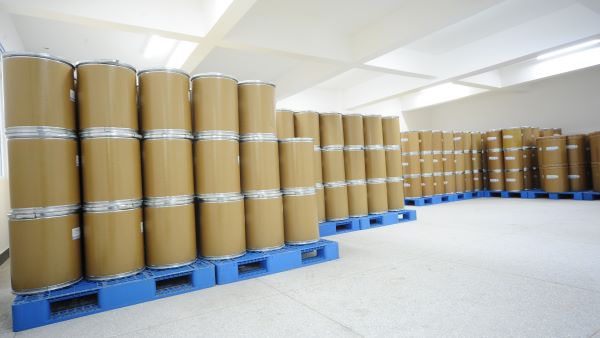
| Bulk Packaging | 25 kg fibre drum (double PE-lined) |
Standard Specifications (COA)
The values below are typical specifications for our standard total alkaloids 5.0% grade. Actual values for each batch are reported in the accompanying COA. Custom specification ranges are available for qualifying orders.
| Test Item | Standard |
| Total Alkaloids (HPLC, expr. as Berberine) | >=5.0% |
| Berberine | Characterised and declared (% w/w); typical 4.0%-6.0% |
| Palmatine | Characterised and declared (% w/w) |
| Tetrahydropalmatine | Characterised and declared (% w/w) |
| Jatrorrhizine | Characterised and declared (% w/w) |
| Columbamine | Characterised and declared (% w/w) |
| Loss on Drying | <=8.0% |
| Total Ash | <=10.0% |
| Lead (Pb) | <=1.0 mg/kg |
| Arsenic (As) | <=2.0 mg/kg |
| Cadmium (Cd) | <=0.5 mg/kg |
| Mercury (Hg) | <=0.1 mg/kg |
| Pesticide Residues | Complies with USP <561> |
| Microbiological (TAMC/TYMC/E.coli/Salmonella) | Complies with USP <61> and <62> |
Botanical Source Description – Barberry
Barberry Extract product is derived from the dried Bark / Root Bark / Fruit of Berberis vulgaris L. (Family: Berberidaceae). B. vulgaris is a deciduous thorny shrub. It is native to Europe, Western Asia, and North Africa. The fruit is small, elongated, and bright red when ripe. In Persia and Central Asia, barberry fruit (zereshk) is widely used as a culinary spice and traditional remedy. In Europe, barberry has a long history of use in herbal medicine. In China, B. vulgaris and related Berberis species are cultivated in Gansu, Ningxia, Qinghai, and Inner Mongolia provinces.
Gansu province is the largest producing region. Dingxi and Linxia areas are the main cultivation zones. The cool, arid climate of northwestern China is well suited to B. vulgaris growth. Berberine is the dominant alkaloid. It typically accounts for 70-80% of total alkaloids. Palmatine and tetrahydropalmatine are the next most abundant. The alkaloid content in B. vulgaris fruit is generally lower than in B. aristata (Indian barberry) or Coptis chinensis (goldthread). However, B. vulgaris fruit offers a more balanced alkaloid profile. It also contains additional compounds such as oleanolic acid and anthocyanins.
Our raw material procurement protocol selects for fruit with total alkaloid content >=5% (dry basis). All incoming lots are authenticated through macroscopic identification, microscopy, and HPLC fingerprinting before acceptance into inventory.
Core Efficacy
The following efficacy summary is based on published scientific literature. It is provided for technical reference only. End-product health claims should be validated against the regulations of the target market.
The primary pharmacological activity of Barberry Extract is mediated by its alkaloid fraction, particularly berberine. Clinical evidence for blood sugar support comes from a landmark meta-analysis of 14 RCTs (Yin et al., Metabolism, 2012; 61(6): 798-809). It found that berberine (500 mg twice daily for 3 months) significantly reduced fasting blood glucose (by ~1.05 mmol/L), 2-hour postprandial glucose (by ~1.34 mmol/L), and HbA1c (by ~0.75%) in type 2 diabetic patients. The effect size was comparable to metformin and glimepiride.
For lipid management, a meta-analysis published in PubMed (2023; PMC12155967) covering B. vulgaris and B. integerrima showed significant reductions in body weight (WMD: -2.25 kg), BMI (WMD: -0.57 kg/m2), total cholesterol (WMD: -19.32 mg/dL), LDL cholesterol (WMD: -18.70 mg/dL), and triglycerides (WMD: -16.70 mg/dL) in type 2 diabetic patients.
The antimicrobial properties of berberine are well characterised. Berberine disrupts bacterial cell membranes and inhibits DNA replication. In vitro studies have demonstrated antibacterial activity against E. coli, Salmonella, Staphylococcus aureus, and Helicobacter pylori. While these antimicrobial effects are well established in laboratory studies, clinical evidence for gut-health applications in humans is more limited. Formulators should be cautious about making gut-health claims without additional human data.
Regulatory & Regional Access Status
The regulatory information below is based on publicly available data. Always verify current requirements with your target market regulator before product launch.
Note: Regulatory status can change. Confirm with the relevant authority or a regulatory consultant prior to export.
| Region / Country | Regulatory Status | Key Notes |
| USA (FDA) | Dietary Supplement (DSHEA) | Berberis vulgaris is listed in the FDA EAFUS database (CAS 94204-54-5). It is generally recognised as safe for use in dietary supplements under DSHEA. It is NOT GRAS-approved as a food additive. The FDA has issued warning letters to companies making disease-treatment claims with berberine products. Structure/function claims are permitted under 21 CFR 101.93 with mandatory disclaimer. |
| EU (EFSA) | Under Review – Draft Safety Opinion | EFSA published a draft safety opinion on berberine-containing plant preparations in May 2026 (TOX-2026-14). The draft raises concerns about potential genotoxicity at high doses. No authorised health claims exist for barberry or berberine under Regulation 1924/2006. Barberry extract may be marketed as a food supplement in the EU. Therapeutic claims are not permitted. The final EFSA opinion is pending and may impose new restrictions. |
| China (NHC/NMPA) | Medicinal Plant | Related Berberis species are listed in the Chinese Pharmacopoeia as medicinal materials. B. vulgaris fruit is used in TCM practice but is not a pharmacopoeial standard. Barberry is cultivated in Gansu, Ningxia, Qinghai, and Inner Mongolia. |
Application Directions & Recommended Dosage
| Application | Recommended Dosage | Dosage Forms | Notes |
| Capsules / Tablets | As per specification | Hard capsules, tablets | Typical serving: 500-1,500 mg extract per day (divided doses). At 5.0% alkaloid grade, a 500 mg capsule delivers ~25 mg berberine. For blood-sugar positioning, align with the 500 mg BID protocol from Yin 2012. Compatible with cinnamon, gymnema, and alpha-lipoic acid. |
| Oral Powder | As per specification | Stick packs, sachets, jars | Water-soluble extract disperses in water. The bitter taste of berberine may require flavour masking. Consider blending with citrus or berry flavours. Compatible with chromium picolinate and vanadium. |
| TCM-Based Formulations | As per specification | Granules, patent medicines | Barberry fruit is used in TCM formulas for clearing heat and drying dampness. Our extract can replace crude herb powder at a typical equivalence ratio of 5:1 to 10:1. Evaluate compatibility with other TCM botanicals. |
Recommended Daily Dosage Reference
- Blood sugar support: 500-1,500 mg standardised barberry extract per day. Take divided into 2-3 doses with meals. This aligns with the clinical protocol from Yin et al. 2012.
- Lipid management: 500-1,000 mg standardised extract per day. Take divided into 2 doses. This aligns with the meta-analysis protocol for cholesterol and triglyceride reduction.
- Formulation note: Berberine has poor oral bioavailability (<5%). Consider micronised or phytosome-encapsulated grades for capsule and tablet formats.
Other Precautions
- Keep containers tightly closed after opening. The extract is hygroscopic. Alkaloids degrade under humid and light-exposed conditions.
- Processing & Formulation Guidance
- For capsules and tablets: The extract is compatible with common excipients. Berberine has poor water solubility. Consider micronised grades or phytosome-encapsulated formats for improved bioavailability.
- For oral powders: Pre-disperse in a small volume of warm water before incorporating into the main batch. The characteristic bitter taste may require flavour masking with citrus, berry, or mint flavours.
- For heat-processed products: Alkaloids are moderately heat-stable. Prolonged thermal exposure (>70 deg.C) may affect some active constituents. Conduct stability testing in your final formulation.
- For TCM-based formulations: Barberry extract can replace crude herb powder at a typical equivalence ratio of 5:1 to 10:1. Evaluate compatibility with other TCM botanicals in your formula.
- Safety & Compliance
- BARBERRY IS LISTED IN THE FDA EAFUS DATABASE (CAS 94204-54-5) FOR USE AS A DIETARY SUPPLEMENT INGREDIENT UNDER DSHEA. It is NOT GRAS-approved as a food additive. Do not market barberry extract as a food ingredient without confirming DSHEA compliance.
- EFSA SAFETY CONCERN: EFSA published a draft safety opinion on berberine in May 2026 (TOX-2026-14). The draft raises concerns about potential genotoxicity at high doses. The final opinion is pending and may impose new restrictions in the EU market. Formulators targeting the EU should monitor this development.
- PREGNANCY AND LACTATION: Berberine crosses the placental barrier. It may cause kernicterus in newborns if administered near delivery. Barberry should be avoided during pregnancy and breastfeeding.
- DRUG INTERACTIONS: Berberine inhibits CYP3A4, CYP2D6, and P-glycoprotein. It may interact with medications metabolised by these pathways. Individuals taking prescription medications should consult a healthcare provider before use.
- GASTROINTESTINAL EFFECTS: Berberine may cause mild GI discomfort (nausea, diarrhea, bloating) at higher doses. Start with a lower dose and gradually increase to improve tolerability.
Why Choose Nutraligting Barberry Extract?
- Barberry is gaining attention for blood-sugar and lipid support. But many suppliers sell it without clear alkaloid data. We make it simple. You get a product with verified berberine content.
- You want a barberry extract with clear berberine content. Many suppliers only give you a total extract weight. They do not tell you how much berberine is actually in it. We test every batch for total alkaloids and individual berberine levels. We put those numbers on the COA. That way you know exactly what you are getting.
- You need to make sure your product follows FDA rules. Barberry is not GRAS-approved for food use. It is only allowed in dietary supplements under DSHEA. We give you clear compliance notes for the US, EU, and China markets. This helps your regulatory team move faster.
- You want competitive pricing from stable domestic sources. Many barberry suppliers rely on wild-harvested material from Europe or the Middle East. China has large cultivated B. vulgaris bases in Gansu and Ningxia. We source directly from these farms. This gives us stable supply and lower cost.
- You need flexible specification options. Most suppliers only offer one fixed grade. Whether you need 5.0% total alkaloids, a custom alkaloid profile, or a different extraction ratio, we can adjust. Just tell us what you need. We will give you a clear quote before you commit.
- You want a partner who can help with more than just the raw material. Our technical team provides formulation guidance. We cover berberine bioavailability. We cover taste masking for the bitter profile. We also share clinical study references. This helps you build your product claims on solid science.
Appendix: References
(The following references are provided for technical reference. Some are open access and can be accessed via PubMed, PMC, or the journal websites.)
[1] Yin J. et al., Metabolism, 2012; 61(6): 798-809. – Meta-analysis of 14 RCTs: berberine reduces FBG, 2hPG, and HbA1c vs placebo.
[2] Berberis meta-analysis (PMC12155967, 2023). – B. vulgaris and B. integerrima reduce weight, BMI, TC, LDL, TG in T2DM patients.
[3] EFSA Draft Opinion on berberine-containing plant preparations (TOX-2026-14, May 2026). – Genotoxicity concern raised.
[4] FDA EAFUS. Berberis vulgaris (CAS 94204-54-5) – Listed for use in dietary supplements under DSHEA.
[5] Wang M. et al., Journal of Ethnopharmacology, 2013. – Berberine activates AMPK. Improves insulin sensitivity and lipid metabolism.
[6] Chinese Pharmacopoeia Commission. Pharmacopoeia of the People’s Republic of China, 2020 Edition. – Berberis species medicinal material monographs.
Frequently Asked Questions
We offer Barberry Extract standardised at 97%, 98%, and 99% berberine content. Custom specifications can be accommodated upon request.
Yes. A Certificate of Analysis, MSDS, and relevant certifications (ISO, Halal) are provided for every shipment.
Our standard MOQ is 1 kg for trial orders, with bulk pricing available for larger quantities such as 25 kg drums. Please contact our sales team for exact terms.
Absolutely. We offer OEM/ODM services including custom packaging sizes, labelling, and documentation tailored to your market requirements.
Store in a cool, dry place away from direct sunlight and moisture. Keep containers tightly sealed when not in use.
Packaging & Shipping
Standard Packaging
- Standard: 25 kg fibre drums with double polyethylene bags.
- Custom: 1 kg aluminium bags, 5 kg cartons, or buyer-specified packaging available.
Shipping Terms
- Shipped via express courier (DHL, FedEx, UPS), air freight, or sea freight depending on order volume.
- Sample orders dispatched within 3–5 business days; bulk orders typically ship within 15–25 days after payment confirmation.
Shelf Life & Storage
- Store in a cool, dry place below 25°C. Protect from light and moisture. Keep containers tightly sealed.