Product Description
Classic European Relaxation and Skincare Herb – Standardized German Chamomile (Chamomile) Extract with Chamazulene / Apigenin
Product Description
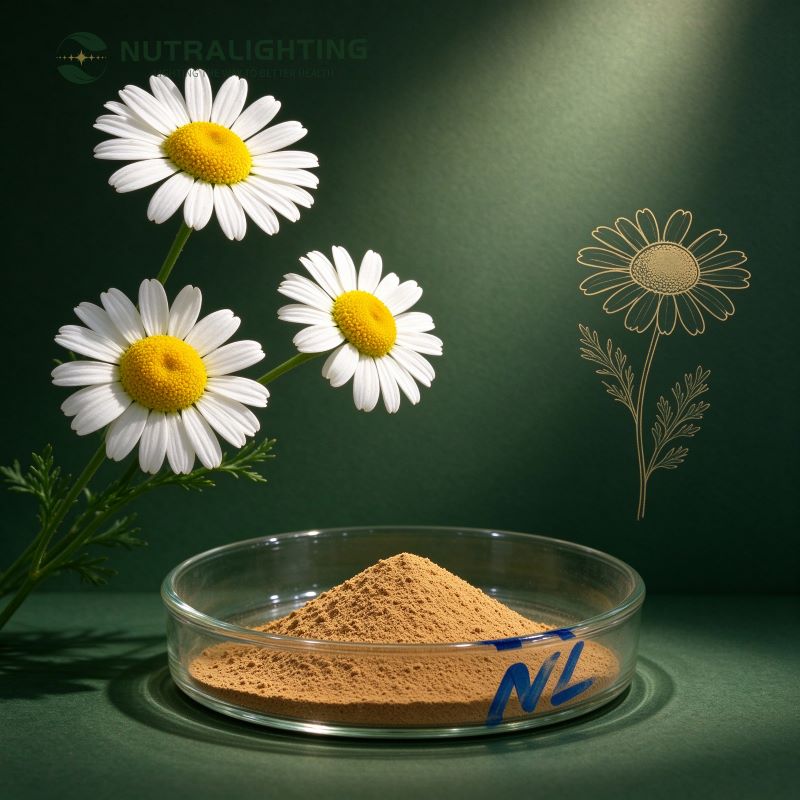
Chamomile / German Chamomile Extract centers on Chamazulene and Apigenin as its active ingredients. It is derived from the dried flowers of German Chamomile (Matricaria chamomilla) of the Asteraceae family, refined into a standardized powder containing stable characteristic components, with Apigenin content up to 1.2%. As a classic plant ingredient in the European aromatherapy and herbal market, it has a strong research foundation in calming the mind, skincare, and anti-inflammatory effects. It is widely used in health foods, functional foods, and personal care formulations. This product uses imported German Chamomile flowers from Hungary, suitable for the development of relaxation and skincare products.
Chamomile extract is highly established in the European aromatherapy and herbal markets, with Hungary and France as the main sources of raw materials. The global market is steadily growing.
Why Choose Nutralighting
- ISO 9001, Halal certified facility
- COA reports available for each batch
- OEM/ODM support with custom standardization levels
- Stable supply chain with global export experience
Basic Information
| Project | Content |
| Extract Name | Chamomile Extract / German Chamomile Extract |
| Botanical Name | Matricaria chamomilla L. |
| Part Use | Dry Flower |
| Appearance | Brownish-yellow powder |
| Solubility | Soluble in water, ethanol, propylene glycol |
| Particle Size | 80-100 mesh (customizable) |
| Recommended Promotional English Name | Matricaria chamomilla Flower Extract, German Chamomile Extract |
| Main Components | Chamazulene, Apigenin |
| Main Specifications | Apigenin 2-5%, Luteolin 1-3% |
| Target Market | Europe, North America |
| Core Application Areas |
|
Standard Specifications (COA)
The following specifications are conventional reference values; the chamomile exact values are subject to the COA report of each batch.
| Testing Items | Standard |
| Chamazulene | Apigenin 1.2% |
| Loss on drying | ≤5.0% |
| Total ash | ≤6.0% |
| Lead (Pb) | ≤1.0 mg/kg |
| Arsenic (As) | ≤2.0 mg/kg |
| Cadmium (Cd) | ≤0.5 mg/kg |
| Mercury (Hg) | ≤0.1 mg/kg |
| Pesticide residues (organochlorine/organophosphorus) | Complies with USP <561> |
| Aflatoxin B1 | ≤5.0 μg/kg |
| Total Aflatoxins | ≤10.0 μg/kg |
| Total Microbial Count (TAMC) | ≤1×10⁴ CFU/g |
| Yeasts and Molds (TYMC) | ≤1×10² CFU/g |
| Escherichia coli | Not detected (1g) |
| Salmonella | Not detected (1g) |
Introduction of Plant Raw Materials
The raw material is the dried flower of chamomile plants, Matricaria recutita L. (German chamomile) or Chamaemelum nobile L. (Roman chamomile). German chamomile is mainly produced in Hungary and France, while Roman chamomile is mainly produced in the UK and Bulgaria. German chamomile is included in Germany’s Commission E. The main active ingredients are chamazulene (blue-purple), apigenin, and luteolin.
Core Efficacy
German chamomile (Matricaria chamomilla) extract has a dual research basis in relaxation and skin care, with the core active ingredients being azulene compounds (chamazulene, content about 0.5%-2%) and apigenin (content about 0.1%-0.5%). Relevant randomized controlled studies suggest that standardized chamomile extract has more research in the areas of mood relaxation and sleep support (Phytomedicine, 2016); its mechanism is related to the regulation of GABA_A receptors and the soothing effects of apigenin. In terms of skin, chamomile extract has a research basis for soothing redness and improving skin discomfort (through inhibition of NF-κB and IL-31 and other inflammatory factor expression). Chamomile essential oil has MIC values of approximately 0.5 mg/mL against Staphylococcus aureus and 1.0 mg/mL against Candida albicans, demonstrating its in vitro antibacterial activity.
Regulatory and Regional Market Access Status
The following information is based on publicly available regulatory data. Actual market access should be subject to the latest regulations of the target country.
| Region/Country | Regulatory Status | Key Notes |
| United States (FDA) | Dietary Supplements / GRAS | Plant extracts are generally regulated as dietary supplements; some ingredients have been recognized as GRAS (specific confirmation is required on a case-by-case basis). USP has included monographs for various extracts. |
| European Union (EFSA) | Traditional Herbal Medicines / Food Supplements | EU Directive 2004/24/EC regulates traditional herbal medicines; extracts as components of food supplements must comply with EU Novel Food Regulation (EU) 2015/2283 requirements (some traditional herbs benefit from simplified procedures). |
| China (NHC/NMPA) | Health Food Ingredients / New Resource Foods | According to the 2020 edition of the Chinese Pharmacopoeia and standards such as GB 16740; some varieties have been included in the list of raw materials for health foods or can be used in the list of ordinary foods, and the latest regulatory status of each variety needs to be specifically verified. |
Application Directions and Recommended Dosage
| Application Direction | Recommended Dosage | Applicable Dosage Forms | Remarks |
| Relaxation / Sleep Support | 300~600 mg/day | Take before bedtime | Helps with relaxation and sleep support |
| Oral solid beverages / instant powders | According to specifications | Strip pack, bag pack, canister | Can be compounded with other functional ingredients, recommended to control the amount with standardized extracts |
| Compressed candy / capsule | According to specifications | Tablet, hard capsule | Each capsule is recommended to contain 250~500 mg of extract, 2~3 times daily |
| Oral liquid / functional beverage | According to specifications | Glass bottle, PET bottle | It is recommended to first disperse in warm water before adding to the system, paying attention to pH stability |
| Personal care and skincare products | 0.1~2.0%(w/w) | Lotion, serum, mask | Solubility and stability need to be evaluated based on the formulation system |
Recommended Daily Dosage Reference
- General health use: Use according to product specifications and the suggested amounts by formulators
- Personal care and skin care: The amount added in the formulation depends on the specific product, recommended 0.1~2.0%
Appendix: References
(The following references are for technical reference; some are open access and can be accessed via PubMed/PMC or the journal’s official website)
[1] Koulivand P.H. et al., Phytomedicine, 2016; 23: 1271-1278.
[2] Arnold I. et al., Phytotherapy Research, 2012; 26: 128-131.
[3] Epstein E.H. et al., Journal of Investigative Dermatology, 1987; 89: 666-671.
Frequently Asked Questions
Yes, we supply COA, HPLC analysis, and certificates of origin for every batch. Our facility is ISO 9001, and Halal certified.
Absolutely. We offer OEM/ODM services with adjustable apigenin/luteolin content, custom mesh sizes, and private labeling upon request.
Packaging & Shipping
Standard Packaging
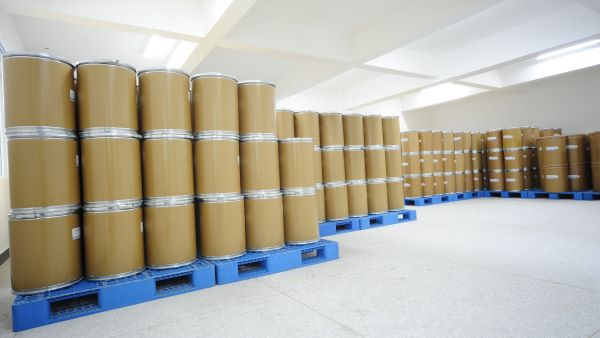
- Standard: 25 kg fiber drums lined with double PE bags.
- Custom: 1 kg aluminum foil bags, 5 kg cartons, or as per buyer requirement.
Shipping Terms
- Lead time: 15-25 days after order confirmation.
- Port: Shanghai / Ningbo, China.
- Terms: FOB, CIF, CFR available.
Shelf Life & Storage
- Store in a cool, dry place away from direct sunlight. Keep containers tightly sealed. Protect from moisture and strong odors.