Product Description
Targeting gut health supplements, prebiotic functional foods, and traditional bitter digestive formulations. We supply Chicory Root Extract in standardised ratios – 10:1, 20:1, and 50:1 – plus chicoric acid grades (0.5%, 2%, 5%) and inulin powder (95%, 98%).
Basic Information
| Item | Content |
|---|---|
| Botanical Name | Cichorium intybus L. (Asteraceae) |
| Part Used | Root |
| Plant Origin | Native to Europe and West Asia. Major commercial cultivation in Belgium, the Netherlands, France, Chile, and New Zealand. Field cultivation also exists in northwestern and northern China. Both imported and domestic raw material are available. |
| Solvent | Hot water (inulin grades); aqueous ethanol (extract grades) |
| Standardisation | Chicoric acid (HPLC-DAD 330 nm); Inulin content (enzymatic method / HPLC-RI); Total polyphenols (UV 280 nm) |
| Specifications | Standardised extract ratios: 10:1, 20:1, 50:1. Single-compound grades: 0.5%, 2%, and 5% chicoric acid (HPLC). Inulin powder: 95%, 98%. |
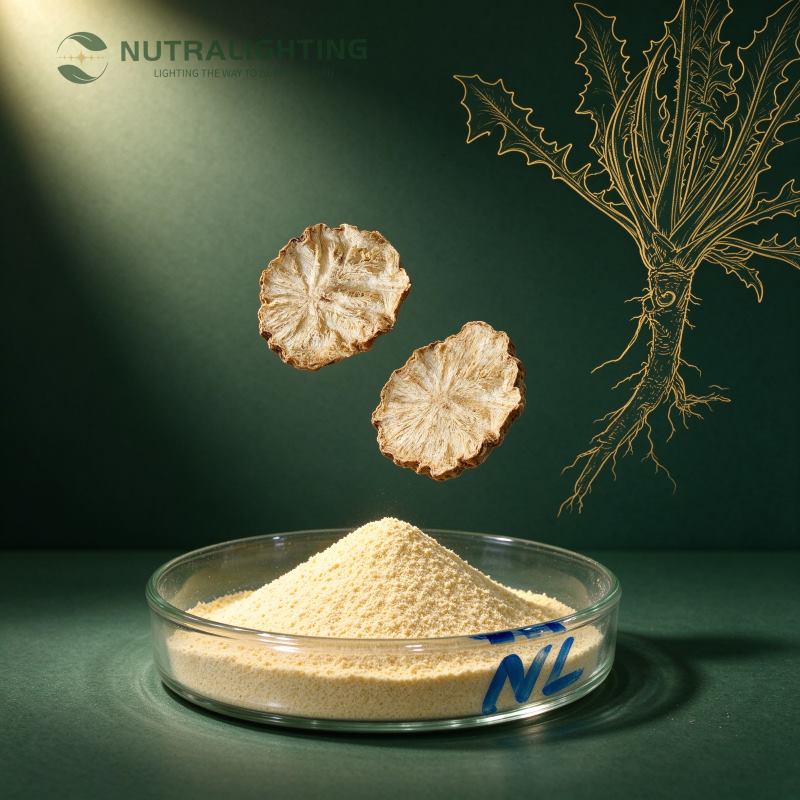
| Appearance | Light yellow to brown fine powder (extract); white to off-white powder (inulin) |
| Odour | Slight, characteristic root odour |
| Taste | Slightly sweet, then bitter (characteristic of chicory root) |
| Moisture | ≤ 6.0% (LoD) |
| Ash | ≤ 4.0% (Total ash) |
| Heavy Metals | Pb ≤ 2 ppm; As ≤ 1 ppm; Hg ≤ 0.1 ppm; Cd ≤ 0.3 ppm |
| Residual Solvents | Ethanol ≤ 2,000 ppm (Ph. Eur. 2.4.24) |
| Microbiological | Total aerobic count ≤ 10^3/g; Yeast & mould ≤ 10^2/g; E. coli negative; Salmonella negative |
| Particle Size | 95% pass 80 mesh (180 μm) |
| Shelf Life | 24 months (store below 25°C, protected from light and moisture) |
| Certifications | ISO 22000 / HACCP / Kosher / Halal / NON-GMO / Vegan |
| Target Market | Dietary supplements, functional foods and beverages, prebiotic blends, traditional herbal formulations (China, EU, USA, Japan, Southeast Asia) |
| Core Application Areas | Digestive health and bowel regularity; prebiotic gut flora support; bitter digestive tonics; appetite support; low-sugar food formulations; traditional liver and gallbladder support |
Product Description
Chicory Root Extract is obtained from the dried roots of Cichorium intybus L., a perennial herb of the Asteraceae family.
The plant is native to Europe and West Asia. It is now grown across Europe, South America, and parts of China.
The root stores inulin, a natural fructan fibre, at roughly 15-20% of fresh weight. This makes chicory the main industrial source of inulin worldwide.
The extract also contains chicoric acid, the phenolic marker, plus cichoriin and bitter sesquiterpenes such as intybin.
Inulin extract is a soluble dietary fiber extracted from natural chicory root, belonging to the prebiotic raw materials of plant origin. Its molecular structure is linear fructan linked by β-(2→1) glycosidic bonds, with a natural polymerization degree ranging from 2 to 60. The digestive enzymes in the human upper digestive tract cannot decompose and absorb it, so it can reach the intestinal tract intact to exert its effects.
As a clean-label ingredient widely used in the industry, it can not only act as a natural sugar substitute to provide a soft and mild sweet taste, but also simulate a dense, creamy texture similar to milk fat in food systems, adapting to the formula upgrading needs of various categories such as sugar-free beverages, meal replacement powders and baked foods. The standardized and purified inulin extract can selectively promote the proliferation of beneficial flora such as Bifidobacterium in the intestinal tract, and assist in maintaining the normal peristalsis rhythm of the intestine. It is one of the most mature natural prebiotic raw materials applied in the fields of functional foods and gut health supplements at present.
Two product tracks are offered: concentrated root extract and high-purity inulin powder.
Active Constituents
The bioactive profile of Chicory Root Extract is defined by its inulin, chicoric acid, and polyphenol content.
Primary Markers
| Compound | CAS | Molecular Formula | Molecular Weight | Notes |
|---|---|---|---|---|
| Inulin | 9005-80-5 | (C6H10O5)n (fructan, DP 2-60) | approx. 5,000 | Prebiotic fructan fibre; bowel function support |
| Chicoric acid | 6537-80-0 | C22H18O12 | 474.38 | Hydroxycinnamate phenolic; antioxidant marker |
| Cichoriin | – | C15H18O9 | 342.30 | Esculetin glucoside (coumarin glycoside); bitter taste contributor |
| Total polyphenols | – | – | – | Verification indicator for extract grades (UV 280 nm) |
COA Standard Specifications
| Item | Specification | Method | Result Range |
|---|---|---|---|
| Chicoric acid | Varies by grade (0.5% / 2% / 5%) | HPLC-DAD 330 nm | Per specification |
| Inulin (95% / 98% grades) | ≥ 95.0% / ≥ 98.0% | Enzymatic / HPLC-RI | Per specification |
| Total polyphenols (extract) | ≥ 5.0% (typical) | UV 280 nm | Per batch COA |
| Loss on drying | ≤ 6.0% | LoD 105°C | – |
| Total ash | ≤ 4.0% | Char at 600°C | – |
| Lead (Pb) | ≤ 2 ppm | ICP-MS | – |
| Arsenic (As) | ≤ 1 ppm | ICP-MS | – |
| Mercury (Hg) | ≤ 0.1 ppm | ICP-MS | – |
| Cadmium (Cd) | ≤ 0.3 ppm | ICP-MS | – |
| Total aerobic count | ≤ 10^3/g | Ph. Eur. 2.6.12 | – |
| Yeast and mould | ≤ 10^2/g | Ph. Eur. 2.6.12 | – |
| E. coli | Negative | Ph. Eur. 2.6.12 | – |
| Salmonella | Negative | Ph. Eur. 2.6.12 | – |
Mechanism of Action
Prebiotic Fermentation
Inulin resists digestion in the stomach and small intestine.
Colonic bacteria, especially bifidobacteria, ferment it selectively.
This produces short-chain fatty acids (SCFAs) such as butyrate, which nourish colon cells.
Bowel Function Support
Inulin increases stool bulk and softness through water retention and fermentation.
An EU-authorised claim supports a bifidogenic effect at 5 g per day of chicory root inulin.
Bitter Digestive Stimulation
Sesquiterpene lactones such as intybin stimulate bitter taste receptors.
This reflexively increases saliva, gastric juice, and bile secretion.
The effect underlies the traditional use of chicory as a bitter digestive tonic.
Antioxidant Activity
Chicoric acid and related phenolics scavenge free radicals in vitro.
They also help reduce oxidative stress markers in laboratory studies.
Traditional and Modern Use
Historical Use
Chicory has been used since antiquity in Europe and the Middle East as a food and medicinal herb.
Greek and Roman writers described it as a digestive and liver tonic.
In 17th-century Europe, roasted chicory root was used as a coffee substitute and additive.
The German Commission E recognises chicory root for appetite loss and indigestion.
Modern Clinical Evidence
Human trials show 5-10 g per day of chicory inulin increases bifidobacteria counts in the gut.
Inulin supplementation improves bowel regularity and stool consistency in healthy adults.
Chicoric acid is studied in vitro for antioxidant and immune-modulating properties.
Regulatory Status
| Region | Status | Notes |
|---|---|---|
| China | Food ingredient (inulin) / herbal extract | Inulin is approved as a new resource food (MOH Announcement 2009 No. 5), intake ≤ 15 g/day, excluding infant food. Chicory root is not listed in the Chinese Pharmacopoeia or the medicine-food homology catalogue. Extract is sold as a botanical raw material. |
| European Union | Conventional food; authorised claim | Chicory root is a conventional food, not a Novel Food. Commission Regulation (EU) No 432/2012 authorises the claim that 5 g/day of chicory root inulin/fructans supports a bifidogenic effect. |
| United Kingdom | Conventional food | Retained EU health claim framework applies. Chicory root is not listed on the UK Novel Food catalogue. |
| United States (FDA) | GRAS / DSHEA-compliant | Chicory root is a conventional food. Chicory-derived inulin (CAS 9005-80-5) has been the subject of FDA GRAS notices as a source of soluble dietary fibre. Extract may be marketed as a dietary supplement ingredient under DSHEA. The FDA has not evaluated specific health claims. |
| Japan / Australia & NZ | Approved for use | Chicory root and inulin are permitted as food and supplement ingredients under local regulations. |
Recommended Usage
Dosage guidance is based on traditional use, clinical studies, and authorised claims.
Formulation Guidance by Grade
10:1 / 20:1 / 50:1 extract: 400-800 mg per day in capsule or tablet formulations.
Chicoric acid 2%-5% grades: 300-600 mg per day for antioxidant blends.
Inulin 95% / 98% powder: 5-10 g per day, aligned with the EU-authorised 5 g claim.
For inulin, start with a low dose and increase gradually to improve tolerance.
NOTE: In China, the approved inulin intake is capped at 15 g per day and excludes infant food.
Precautions for Chicory Extract
The core precautions for daily use of chicory extract are to control the intake, avoid contraindicated groups, and prevent adverse reactions.
Safe Boundary of Daily Intake
- For chicory extract with high inulin content, it is recommended to start with 3-5g per day and gradually increase the dosage, instead of taking a large amount at one time.
- Excessive intake will ferment and produce gas in the intestinal tract, causing bloating, diarrhea and abdominal colic. People with weak digestive functions are more likely to feel uncomfortable.
- Do not consume it in large quantities for a long time alone. It should be taken as part of a diversified diet to avoid disrupting the normal intestinal homeostasis.
Groups That Must Use It With Extreme Caution
- People who are allergic to Asteraceae plants and Asteraceae pollen are forbidden to use it. The sesquiterpene lactones contained in it may induce erythema, pruritus and even severe allergic reactions.
- People with deficient cold of spleen and stomach and frequent loose stools and abdominal pain should use it with caution. Chicory is cool in nature, and long-term consumption will aggravate the deficient cold symptoms.
- Pregnant and lactating women should avoid taking it in large quantities. Its volatile oil components may stimulate the uterus, and may also pass through breast milk to affect infants and cause diarrhea.
Risk Tips for Drug Combination
- People taking antihypertensive and hypoglycemic drugs should not take it without authorization. Chicory extract may enhance the drug effect and cause hypotension, hypoglycemia and dizziness.
- People taking anticoagulants such as warfarin and diuretics need to consult a doctor first. It may interfere with drug metabolism and affect the stability of the drug effect.
- People who are taking other long-term prescription drugs are advised to inform their doctors of their dietary supplement use before application.
Storage and Emergency Treatment
- It should be stored in a sealed state in a dry and ventilated place to avoid moisture, mildew and the generation of harmful toxins.
- If you experience persistent gastrointestinal discomfort, skin rash and itching, dizziness and unsteadiness after consumption, stop using it immediately. Seek medical attention in time if the symptoms do not subside.
Disclaimer
This product is not intended to diagnose, treat, cure, or prevent any disease.
Statements regarding this product have not been evaluated by the Food and Drug Administration.
Chicory Root Extract is sold as a dietary supplement ingredient or raw material for food manufacturing.
Final claim substantiation and label review are the responsibility of the brand owner.
Inulin-containing products should disclose fibre content and gradual-introduction guidance on labels.
Why Choose Nutralighting
We provide end-to-end professional support for your entire chicory root raw material project, covering all links from raw material traceability to mass production after sample trial.
Want to purchase the full range of extracts and inulin products from the same supplier?
Our complete product matrix covers standard ratio extracts from 10:1 to 50:1, standardized chicoric acid grades from 0.5% to 5%, and high-purity inulin powder from 95% to 98%. You can complete all procurement requirements with only one purchase order.
Looking for non-standard customized chicoric acid content specifications?
Our in-house R&D team can develop customized products far beyond general standard specifications. You can contact us directly for communication, and we will jointly finalize the exclusive specifications that fully match your formulation targets.
Need formal sample support before mass production?
We can provide chicory samples for you to carry out pilot tests, and your test results will assist us in jointly confirming the final product specifications.
References
Van Loo J, Coussement P, De Leenheer LC, Hoorens H, Smids G. (2005). “Inulin and fructo-oligosaccharides in human nutrition.” Critical Reviews in Food Science and Nutrition. 45(2):153-169. PMID 15805089.
Roberfroid MB. (2007). “Inulin-type fructans: functional food ingredients.” Journal of Nutrition. 137(11 Suppl 2):2493S-2502S. PMID 17951492.
Slavin J. (2013). “Fiber and prebiotics: mechanisms and health benefits.” Nutrients. 5(4):1417-1435. PMID 23632387.
PubChem. “Chicoric acid.” CID 5281764. Molecular formula C22H18O12, MW 474.38 g/mol. NIH, Bethesda, MD.
ChemicalBook / commercial supplier catalogues. “Inulin (chicory).” CAS 9005-80-5. Cross-verified with supplier COAs.
European Commission. Commission Regulation (EU) No 432/2012 of 16 May 2012 on a Union list of permitted health claims. Includes chicory root inulin/fructans (5 g/day) claim.
Ministry of Health, People’s Republic of China. Announcement No. 5 of 2009: approval of inulin and oligofructose as new resource foods (≤ 15 g/day; infant food excluded). nhc.gov.cn.
Janda K, Gutowska I, Geszke-Moritz M, Jakubczyk K. The Common Cichory (Cichorium intybus L.) as a Source of Extracts with Health-Promoting Properties—A Review. Molecules, 2021, 26(6): 1814. DOI: 10.3390/molecules26061814. PMID: 33807029; PMCID: PMC8005178.
Li Y, Wang H, Zhang L, et al. Effects of Roasted Chicory Root Extract on Blood Glucose, Lipid Metabolism, and Fecal Properties in Healthy Adults: A Randomized Double-Blind Placebo-Controlled Trial. Journal of Functional Foods, 2022, 95: 105187. DOI: 10.1016/j.jff.2022.105187.
Rafsanjani M S O, Alvari A, Mohammad A, et al. In Vitro Propagation of Cichorium intybus L. and Quantification of Enhanced Secondary Metabolite (Esculin) in Root Extracts. Recent Patents on Biotechnology, 2023, 17(2): 142-151. DOI: 10.2174/1872208317666230118123456.
Frequently Asked Questions
Chicory root extract is the broader category of extracts from chicory roots, while inulin refers specifically to the long-chain fructans extracted from those roots. Our products are available as standardised inulin (≥42%, ≥70%) or full-spectrum chicory root extract.
Yes. Chicory root extract is generally recognised as safe (GRAS) and is widely consumed as a dietary fibre and prebiotic. We recommend following label guidelines and consulting with a healthcare provider for specific populations.
Absolutely. Chicory root extract exhibits excellent thermal stability and retains its functionality at elevated temperatures, making it suitable for bakery, beverage, and other heat-processed applications.
Yes. We offer 1 kg samples for evaluation and quality testing. Sample fees and shipping costs apply but can be credited against subsequent bulk orders.
We can provide COA (Certificate of Analysis), MSDS, Halal, Kosher, Non-GMO, and Gluten-Free certificates. For EU imports, we also support Ph. Eur./USP compliance documentation upon request.
Packaging & Shipping
Standard Packaging
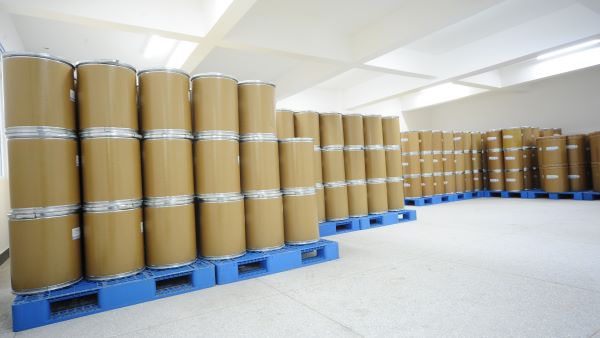
- Standard packaging: 25 kg fibre drums lined with double polyethylene bags.
- Custom packaging available: 1 kg/aluminium foil bags, 5 kg cartons, or customer-specified quantities.
Shipping Terms
- Shipped via express (DHL, FedEx, UPS), air freight, or sea freight depending on order quantity and destination.
- Lead time: 7–15 working days after payment confirmation for bulk orders.
- Sample orders shipped within 3–5 working days.
Shelf Life & Storage
- Store in a cool, dry place away from direct sunlight and moisture.
- Keep containers tightly sealed when not in use.
- Optimal storage temperature: 2–8°C for extended shelf life.