Product Description
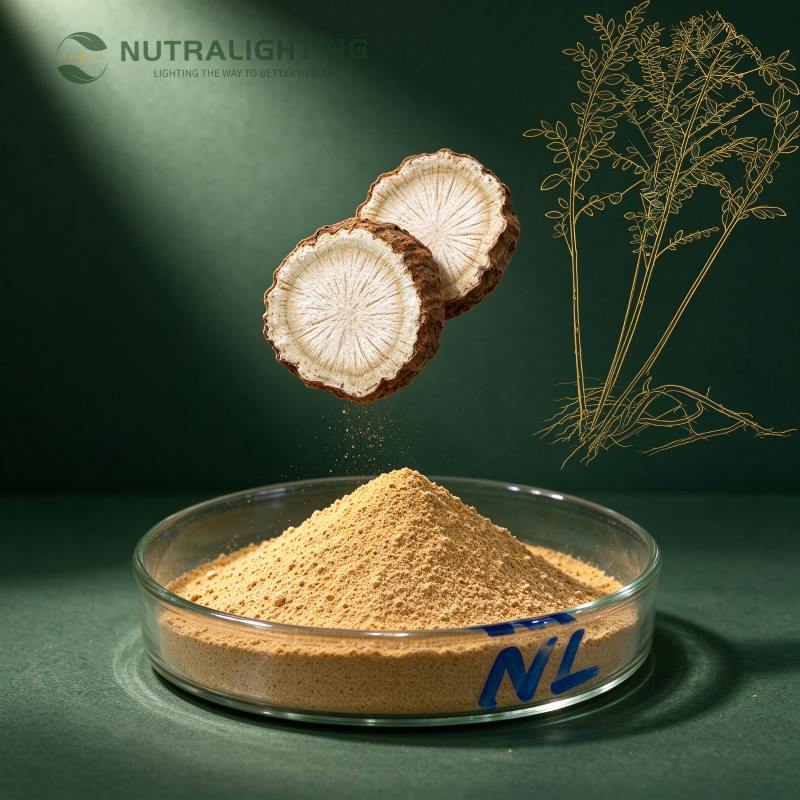
Our Sophora flavescens Root Extract has as its active ingredients quinolizidine alkaloids – matrine, oxymatrine, sophocarpine and sophoridine, as well as the prenylated flavonoid kurarinone. The specifications available cover ratio extracts 5:1, 10:1 and 20:1 and standardized specifications (total alkaloids ≥5%, matrine ≥10%, oxymatrine ≥98%; all of them can be customized to the content specified by different types of customers).
Product Description
For formulators in personal care, skincare, and functional foods, Sophora flavescens extract centers on standardized matrine and oxidized matrine to provide quantifiable antibacterial and soothing support, making it a stable choice among naturally derived active ingredients.
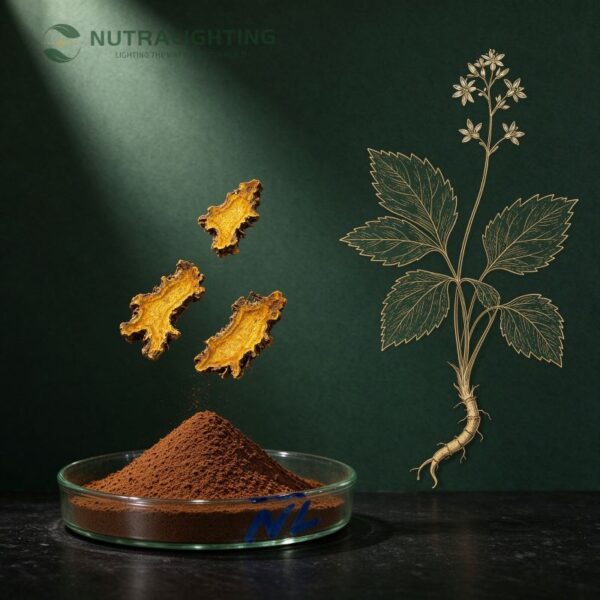
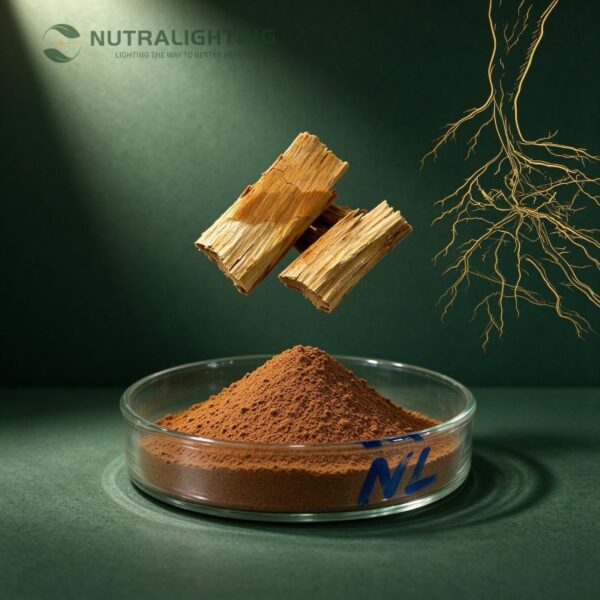
Sophora Flavescens Extract (Ku Shen Extract) is made from the dried root of Sophora flavescens, a leguminous plant. Through acid water extraction, ion exchange purification, and spray drying and purification, it is standardized concentrated powder characterized by matrine and matrine oxide as active ingredients. It meets the 98% HPLC quality standard and has multiple effects including antibacterial, skin care, and anti-inflammatory properties. It is widely used in health foods, functional foods, and personal care. This product is carefully prepared from authentic Hebei Sophora flavescens, with stable content of matrine and matrine oxide, making it a high-quality ingredient for antibacterial soothing and skincare products.
Sophora flavescens is a classic Chinese medicine in China that clears heat and dries dampness. Hebei and Liaoning are the main production areas, and it is widely used in traditional applications such as antibacterial and skin care.
Why Source from Nutralighting
Direct access to certified botanical growing bases in China – Our Sophora flavescens root is purchased directly from standardised cultivation bases and cooperatives in the northern main production areas of China (Shanxi, Hebei, Henan, Gansu, Liaoning, Shaanxi), with per-batch sampling, origin and pesticide-residue screening, and batch numbers that link the raw material to the finished extract.
Stable supply chain with consistent lot-to-lot quality – Every batch of Sophora flavescens Root Extract is assayed by HPLC for total alkaloids, matrine and oxymatrine (regular range: total alkaloids ≥5%, matrine ≥10%, oxymatrine ≥98%), and the results are recorded in the batch COA, so the alkaloid profile stays consistent from lot to lot.
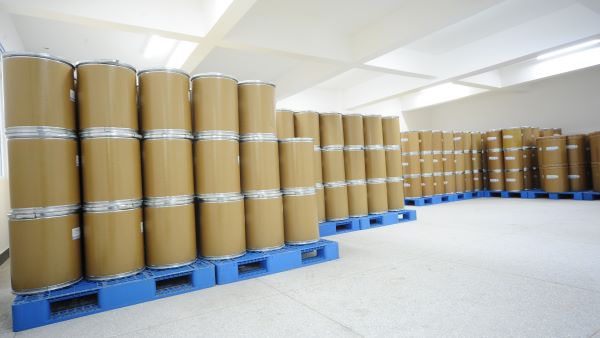
Flexible pack sizes from 1 kg to bulk container quantities – 1 kg aluminium foil bags and 25 kg fibre drums as standard, with sub-packaging available on request.
Support for private labeling and OEM formulation requirements – Content, particle size, heavy metal and microbiological limits can be adjusted to your formula or in-house standard; the assay can be re-checked by your USP, EP or in-house method with the original chromatogram attached; private-label packing and document sets can be arranged.
Fast sample dispatch and professional technical documentation – Samples are taken from the same production standard as bulk orders and dispatched quickly; COA, TDS, MSDS and, on request, non-GMO, allergen-free, BSE/TSE-free statements and solvent residue reports accompany the goods.
Basic Information
| Item | Content |
|---|---|
| Extract name | Sophora flavescens Root Extract |
| Latin name | Sophora flavescens Aiton (Fabaceae, genus Sophora) |
| Pharmacopoeia name | Sophorae Flavescentis Radix (Ku Shen) |
| Other names | Ku Shen, Bitter Root, Shrubby Sophora Root, Sophora flavescens root extract |
| Part used | Dried root |
| Extraction ratio | 5:1, 10:1, 20:1 (customizable) |
| Main active ingredients | Matrine, oxymatrine (kushenin), sophocarpine, sophoridine, oxysophocarpine; flavonoids: kurarinone, isokurarinone, kushenol |
| Key specifications | Total alkaloids ≥5%; matrine ≥10% (customizable to ≥98%); oxymatrine ≥98% |
| Appearance | Ratio extract: light brown to brown-yellow fine powder; high-purity monomer: white to off-white crystalline powder |
| Particle size | 80 to 100 mesh (adjustable) |
| Target market | Customers in cosmetics and personal care, oral care, animal health and feed additives, plant-derived agricultural inputs and other fields |
| Core application directions | Cleansing and care formulas, oral care, animal health, raw material for plant-derived biological pesticides |
| Allergen and use note | High-purity alkaloid powder is irritating to skin, eyes and the respiratory tract, and protection is needed in production; the added amount in the end formula must be determined according to the regulations of the target market |
Standard Specifications (COA Reference Values)
| Test item | Reference limit | Test method |
|---|---|---|
| Matrine | ≥10% (example; 5%/20%/98% optional) | HPLC |
| Oxymatrine | ≥98% | HPLC |
| Identification | Consistent with the reference substance chromatogram | TLC |
| Loss on drying | ≤5.0% | Oven drying method |
| Total ash | ≤5.0% | Ignition method |
| Lead (Pb) | ≤1.0 mg/kg | ICP-MS/AAS |
| Arsenic (As) | ≤2.0 mg/kg | ICP-MS/AAS |
| Cadmium (Cd) | ≤0.5 mg/kg | ICP-MS/AAS |
| Mercury (Hg) | ≤0.1 mg/kg | ICP-MS/AAS |
| Pesticide residues | Meet the corresponding limits of USP Chapter 561 or EU (EC) No 396/2005 | GC-MS/LC-MS/MS |
| Aflatoxin B1 | ≤5.0 μg/kg | HPLC |
| Total aflatoxins | ≤10.0 μg/kg | HPLC |
| Total aerobic plate count | ≤10³ cfu/g | Plate method |
| Moulds and yeasts | ≤10² cfu/g | Plate method |
| Salmonella/E. coli | Not detected | Plate method |
The above are routine reference values, and the actual indexes are subject to the independent COA of each batch; heavy metal and microbiological limits can be tightened to the customer’s standard (for example, according to USP, EP or the customer’s in-house standard). For food uses such as dietary supplement raw material, the microbiological and solvent residue standards need to be agreed separately in the contract.
Introduction to Plant Material
Sophora flavescens is a perennial herb to subshrub of the genus Sophora in the family Fabaceae, with the scientific name Sophora flavescens Aiton; the pharmacopoeia includes its dried root, which is dug in spring and autumn, washed after the root head and small branch roots are removed, and then dried or sliced while fresh. Under the Ku Shen item in Volume I of the Pharmacopoeia of the People’s Republic of China (2020 edition), the test requirements are: water content not more than 11.0% and total ash not more than 8.0%; under the assay item, the total amount of matrine and oxymatrine is required to be not less than 1.2% (calculated on the dried basis). The Ku Shen item in the Veterinary Pharmacopoeia of the People’s Republic of China (2020 edition) adopts the same content criterion.
Sophora flavescens has strong adaptability and is distributed in many places in China except the high-cold and extremely arid regions; the main production areas are concentrated in northern China (North China, Northwest China, Northeast China and elsewhere, such as Hebei, Shanxi, Shaanxi, Gansu, Henan, Liaoning, Jilin and Heilongjiang). At present wild resources and artificial cultivation coexist in China, the cultivated area is expanding year by year, and the raw material supply is mainly domestic harvesting and domestic cultivation in China. The medicinal material contains two characteristic types of ingredients, quinolizidine alkaloids and prenylated flavonoids, which are the main basis for the quantitative determination of Sophora flavescens extract.
Core Efficacy
The following efficacy overview is based on published scientific research and traditional applications. Specific efficacy should be evaluated in combination with the product formulation and usage dosage.
Anti-inflammatory and anti-fibrotic direction (study object: oxymatrine). Existing studies suggest that oxymatrine can reduce the process of tissue fibrosis in experimental models by inhibiting the activation and proliferation of hepatic stellate cells, reducing the expression of α-smooth muscle actin (α-SMA) and type I collagen, and down-regulating TGF-β1 and NF-κB related signalling; in a small-sample clinical study of people with chronic hepatitis B related liver fibrosis, improvements in serum fibrosis markers and liver stiffness values were observed. The above conclusions come from experimental models and clinical studies and cannot be stated as being able to treat, cure or prevent any disease.
Antibacterial and anti-inflammatory direction (study object: Sophora flavescens extract and total alkaloids). In vitro studies show that Sophora flavescens extract has a certain inhibitory effect on a variety of bacteria, fungi and parasites, and its anti-inflammatory activity is related to the inhibition of the release of pro-inflammatory factors (such as TNF-α and IL-6). The relevant conclusions come mostly from in vitro and animal experiments, and human evidence is limited.
Neuroprotective direction (study object: the alkaloid-free ethyl acetate fraction). A study published in Phytomedicine (2009) using a rat model of focal cerebral ischaemia showed that an alkaloid-free ethyl acetate extract of Sophora flavescens root (mainly containing 45.5% kurarinone and 14.7% sophoraflavone G) can reduce infarct volume and improve neurological deficit scores, with the mechanism involving inhibition of caspase-3 activation and cell apoptosis.
Agricultural bioactivity direction. Matrine has already obtained pesticide registration in China as a plant-derived active ingredient (such as soluble liquid and wettable powder formulations) and is used for the control of pests and diseases in some crops; the registration information can be verified in the official pesticide registration database.
Regulatory and Regional Access Status
The following information is compiled based on publicly available regulatory data. For actual market access, please refer to the latest regulations of the target country.
| Region | Regulatory status | Key notes |
|---|---|---|
| United States | Can be used as a cosmetic ingredient; use as a dietary supplement ingredient needs to be assessed under DSHEA | The INCI name for cosmetic use is SOPHORA FLAVESCENS ROOT EXTRACT. As a dietary supplement ingredient, it must be assessed whether it is a new dietary ingredient (NDI) and the corresponding notification obligation must be performed; we do not claim that GRAS status has been obtained or that NDI notification has been completed. If the page contains structure-function statements, an FDA disclaimer must be provided. |
| European Union | Cosmetics are governed by (EC) No 1223/2009; food use is assessed under the novel food regulation (EU) 2015/2283 | As a food or food supplement ingredient, the novel food authorisation status must first be confirmed; some member states have separate restrictions on plant ingredients containing alkaloids, and each country must be confirmed before export. |
| China | Included as a Chinese medicinal material in the Chinese Pharmacopoeia | Ku Shen is not listed in the catalogue of substances that are both food and Chinese medicine according to tradition, nor is it within the scope of the list of items that can be used in health food; it can be used as a cosmetic raw material, a veterinary drug and feed (with the corresponding licence) and a plant-derived pesticide (with pesticide registration). |
| Australia | Governed by the TGA herbal ingredient framework and the AICIS cosmetics framework | As a listed complementary medicine ingredient, it must meet the TGA permitted ingredient requirements; cosmetics are separately classified and notified under AICIS. |
Regulations change as supervision is updated; the above status is a framework description at the time of writing, and before export it is essential to confirm item by item with the competent authority or a compliance adviser in the target market.
Application Directions and Recommended Dosage
| Application direction | Recommended dosage | Applicable dosage forms | Notes |
|---|---|---|---|
| Cosmetic and skin care (leave-on) | Ratio extract 0.1% to 1.0%; high-purity monomer 0.01% to 0.1% | Serums, creams, masks | Formula compatibility and stability tests are recommended |
| Cosmetic and wash products (rinse-off) | Ratio extract 0.2% to 2.0% | Cleansers, shampoos, body washes | The stability of alkaloids in alkaline systems needs to be assessed |
| Oral care | 0.05% to 0.5% | Toothpaste, mouthwash | Needs to be combined with an assessment of taste and mucosal irritation |
| Animal health and feed additives | Follow the veterinary drug or feed regulations and product standards of the target country | Premixes, powders | Within China, follow the Veterinary Pharmacopoeia and the relevant provisions on feed additives |
| Plant-derived agricultural inputs | Active ingredient 0.3% to 1.5% (according to the registered formulation) | Soluble liquids, wettable powders | Pesticide registration in the target market must be obtained first |
| Dietary supplement raw material | No recommended intake is given | Capsules, tablets | A compliance assessment in the target market must be completed first; Ku Shen is a medicine in China, not a food raw material |
Daily dosage reference
In the literature, the usual decoction dose of the Ku Shen medicinal material is 4.5 to 9 g per day (the criterion of clinically usual dosage in the Chinese Pharmacopoeia), but this is a usage of the crude drug decoction pieces and does not apply to extract raw material. In some clinical studies the dose of oxymatrine is 300 to 600 mg per day (in divided doses), and the usual dose in matrine-related studies is 100 to 300 mg per day; the above doses are only research doses in the literature, not recommended intakes, and the actual formula design must be determined by the customer in light of the target market regulations and its own compliance assessment.
Other Precautions
- Sophora flavescens and its alkaloid ingredients have a certain toxicity; dust protection should be provided in the production and compounding of high-purity powder, and direct contact with skin and eye mucosa should be avoided.
- In the traditional use of Chinese medicine, Ku Shen should not be used together with Li Lu (Veratrum) (the criterion of the “eighteen incompatible ingredients” incompatibility); customers involving compound products should assess this themselves.
- The use restrictions relating to pregnant and breastfeeding people and people with abnormal liver and kidney function are matters of end-product labelling and regulation and must be labelled according to the requirements of the target market.
- This product is an industrial raw material, cannot replace prescription drugs, and no statement of disease diagnosis, treatment, cure or prevention may be made on the label or in publicity.
- It is only for B2B enterprises with the corresponding qualifications to use in compliant formula development, and is not sold directly to individual consumers.
Appendix: References
[1] Pharmacopoeia of the People’s Republic of China, 2020 edition, Volume I, Ku Shen item: water content not more than 11.0%, total ash not more than 8.0%; total amount of matrine and oxymatrine not less than 1.2%.
[2] Veterinary Pharmacopoeia of the People’s Republic of China, 2020 edition, Ku Shen item: total amount of matrine and oxymatrine not less than 1.2%.
[3] China pesticide registration data (China Pesticide Information Network, ICAMA): matrine formulation registration numbers PD20101681, PD20130430, PD20132710 and PD20184106 (soluble liquids, wettable powders).
[4] Oh Ki et al. Neuroprotective effects of an alkaloid-free ethyl acetate extract from the root of Sophora flavescens Ait. against focal cerebral ischemia in rats. Phytomedicine, 2009. doi:10.1016/j.phymed.2009.03.017
[5] Public reports on the main production areas of Sophora flavescens (production areas such as Qinyuan in Shanxi and Jianping in Liaoning): public reports such as the China Agricultural and Rural Information Network.
[6] Research progress on the pharmacological effects of oxymatrine against liver fibrosis (a Chinese review): complete volume, issue and pages to be supplemented.
[7] Kong S, Liao Q, Liu Y, et al. Prenylated Flavonoids in Sophora flavescens: A Systematic Review of Their Phytochemistry and Pharmacology[J]. American Journal of Chinese Medicine, 2024, 52(4): 1087. DOI: 10.1142/S0192415X24500447.
[8] Kong S, Liao Q, et al. Efficient and Selective Extraction of Prenylated Flavonoids from Sophora flavescens Using Ultrasound-Assisted Hydrophobic Ionic Liquid and Characterization of Extraction Mechanism[J]. Molecules, 2025, 30(3): 500. DOI: 10.3390/molecules30030500.
[8] Park H, Kim E J, Kim E Y, et al. Sophora flavescens Aiton alleviates particulate matter-exacerbated asthma through modulation of ROS/MAPK/autophagy responses[J]. Journal of Ethnopharmacology, 2025: 120440. DOI: 10.1016/j.jep.2025.120440.
Frequently Asked Questions
We employ ethanol-water co-solvent extraction followed by concentration, filtration, and spray drying. The process is optimized to preserve active isoflavonoids and alkaloids while ensuring low solvent residuals.
Yes. We offer standard and customized specifications for matrine and oxymatrine content based on your formulation requirements.
We provide COA, MSDS, HALAL/ISO certificates, free-sale certificate, origin certificate, and third-party test reports. Additional phytosanitary and fumigation certificates are available upon request.
Samples are dispatched within 3-5 business days. Bulk orders typically ship within 15-25 business days after payment confirmation, depending on quantity and packaging customization.
Yes. We offer white-label packaging, custom bag printing, and bulk drum options. Minimum quantities apply for custom packaging.
Packaging & Shipping
Standard Packaging
- Standard: 25 kg double-layer paper drum with inner PE liner.
- Custom: 1 kg aluminum foil bags, 5 kg cartons, or bulk IBC containers available.
- Private labeling and custom packaging offered on request.
Shipping Terms
- Express (DHL, FedEx, UPS) for samples - 5-7 business days.
- Air freight for bulk orders - 7-12 business days.
- Sea freight for container quantities - 25-40 business days depending on destination port.
- FOB Shanghai / CIF / DDP terms supported.
Shelf Life & Storage
- Store in a cool, dry place away from direct sunlight and moisture.
- Keep containers tightly sealed when not in use.
- Recommended storage temperature: 2-8°C for extended shelf life.